
The Market Can't Price the Frontier

Cheap intelligence and American frontier leadership are complements, not substitutes.
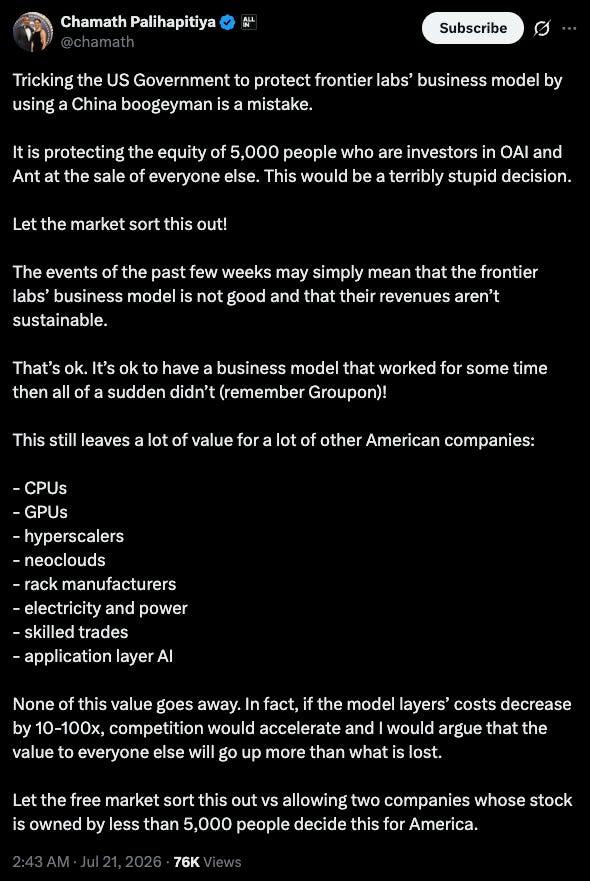
The United States government does not owe OpenAI, Anthropic, or any other lab a durable business model. It certainly does not owe their investors a protected return. National security cannot become a magic phrase that freezes competition, blocks cheaper models, and turns a temporary lead into a permanent entitlement.
If Chinese and open models can do useful work at a fraction of the cost, American companies should use them. If frontier labs cannot justify premium prices for routine workloads, the market should compress those prices. That is competition doing its job.
Chamath is right about more of this than the defenders of frontier labs may want to admit.
I made much of this same argument in Frontier AI vs Chinese AI vs Open Source Self-Hosted AI. The model is not the whole product. The harness matters. Routing matters. Trust, permissions, context, memory, tools, evaluations, and workflow design matter. Most importantly, cost per token is a distraction. The useful economic measure is cost per completed unit of work.
A cheap model that finishes the task is valuable. A premium model used where a cheaper model would work is waste.
Chinese competition is not a boogeyman. It is a price-performance signal. Open models and efficient Chinese labs are attacking the assumption that intelligence must remain scarce, closed, and expensive. That pressure is good for builders, good for enterprises, and ultimately good for America.
But this is where I part company with Chamath’s argument.
A weak token-selling business does not prove that frontier research is a bad investment. It may prove that we are measuring the investment inside the wrong boundary.
The Frontier Creates the Commodity
The mistake is treating a frontier lab as if it were only a SaaS company.
If the lab sells access to a model, we look at API revenue, inference costs, margins, and customer retention. Those are sensible measures for the commercial product. They are not enough to measure the value of the research engine producing the next class of capability.
Frontier labs do the expensive, uncertain work of finding out what is possible. They train at scales that expose new behaviors. They build new architectures, new data systems, new evaluation methods, new inference techniques, and new ways to coordinate models with tools. They discover the capability before the rest of the market learns how to compress it, distill it, route around it, or reproduce it cheaply.
This does not mean every Chinese or open model is merely a copy. It does not mean the American labs deserve ownership of every idea that follows. Innovation is distributed, and competitive pressure often produces real breakthroughs in efficiency.
But commoditization is still downstream of invention.
The cheap layer spreads capability. The frontier layer creates new capability to spread. We need both.
In my earlier piece, I argued that the premium model is becoming the escalation path rather than the default. That remains true. A config change can go to a cheap model. A routine bug fix can go to a local model. A hard architecture problem can escalate to the frontier.
But an escalation path only works if it keeps escalating.
If nobody funds the uncertain work at the top, the routing table eventually stops improving. We get better at allocating yesterday’s intelligence while someone else determines tomorrow’s frontier.
America cannot accept that trade.
The Infinite Loop Is the Product
At the deployment layer, the harness is the agent.
At the frontier, the loop is the product.
A more capable model does not simply produce a better chatbot. Place it inside a research harness and it can propose experiments, write code, search design spaces, test hypotheses, analyze failures, and generate the next round of work. Connect it to simulators, scientific instruments, chip-design tools, software repositories, robotics facilities, and automated evaluators, and the model becomes part of a research system.
Then the system begins to feed itself.
A better model helps design better algorithms. Better algorithms make training and inference more efficient. Better agents improve software, data pipelines, and evaluation systems. Better chip layouts and compilers produce more useful compute. Better compute supports the next model. The next model becomes a stronger research operator, and the cycle begins again at a higher level.
This is not science fiction. The early mechanisms are already visible. Google DeepMind’s AlphaChip has helped design layouts used in multiple generations of Google’s TPU hardware. Chips helped build AI, and AI now helps build better chips.
AlphaEvolve makes the loop even clearer. It has been used to improve data-center scheduling, modify a circuit for a future TPU, and optimize a core Gemini training kernel. The system used frontier models to improve the infrastructure and algorithms used to train frontier models.
Do you see what’s already happening?
We can build autonomous research labs that run large portfolios of software and scientific experiments. We can build applied engineering labs where agents test thousands of designs across hardware, networking, compilers, energy, cooling, robotics, and manufacturing. We can build AI-enabled scientific facilities where models help form hypotheses, schedule instruments, read results, diagnose failed experiments, and decide what to test next.
Human judgment remains essential. Researchers choose the important problems, build the evaluation systems, inspect strange results, and decide what is safe and worth pursuing. But the volume and speed of attempted work can rise by orders of magnitude.
This is accelerating acceleration.
Each gain in intelligence improves the machinery used to search for the next gain. Each improvement in hardware, software, and research operations shortens the cycle again. The strategic asset is not one model checkpoint. It is the compounding system that keeps producing better ones.
Some Strategic Labs Will Look Uneconomic
The market is very good at pricing value a company can capture.
It is less reliable at pricing value that spills across an economy.
A frontier lab may spend billions creating a capability, only to watch much of the benefit flow to cloud providers, chip companies, power producers, application developers, hospitals, manufacturers, defense systems, universities, and millions of individual operators. The lab bears a concentrated cost while the country receives a distributed return.
In economics, that is a positive externality. In plain language, the lab creates value that someone else gets to keep.
This is why a strategically vital lab can look like a bad stand-alone business. Its API margins may be thin. Its training costs may be brutal. Its direct revenue may never match the value created downstream.
That does not make the work uneconomic.
It means the accounting boundary is wrong.
The most important return may appear as faster drug discovery, better logistics, stronger cyber defense, more efficient energy systems, improved industrial design, scientific breakthroughs, and whole new categories of companies. OpenAI’s recent FrontierScience work describes early evidence of frontier models shortening parts of scientific workflows from days or weeks to hours while also making clear how much open-ended research capability remains to be built.
Now compound those gains across every major research field and critical industry.
Even a small number of labs that never become attractive token businesses could still produce enormous national returns. Their economic impact would show up everywhere except their own income statements. Their national security value would be even harder to capture through an API invoice.
Non-economic does not mean worthless.
Sometimes it means the asset is infrastructure.
Protect the Capacity, Not the Cap Table
Chamath’s warning still matters because any national strategy can be captured by incumbents.
“Protect the frontier” can become a polite way of saying “protect our margins.” That would be a mistake.
The answer is not to declare two companies too important to fail. It is not to ban cheap competitors, force every workload through premium American APIs, or use China to excuse weak execution.
The answer is to fund frontier capacity without guaranteeing incumbent economics.
Government can use competitive, milestone-based contracts to buy research outcomes. It can expand shared national compute for universities, startups, and independent researchers. It can create autonomous research facilities around energy, materials, biology, manufacturing, and defense. It can fund hard evaluations, secure test environments, semiconductor research, power infrastructure, and the applied engineering needed to turn model capability into real systems.
Public money should also buy public value. That can mean research access, broad licensing, shared infrastructure, security testing, or the release of selected results after a sensible lead time. The goal is not to socialize every model. It is to prevent public investment from becoming a blank check for private scarcity.
Competition should remain brutal.
Labs should have to prove progress. New entrants should be able to challenge incumbents. Open models should keep pressing prices down. Enterprises should route each workload to the system that completes it best. Bad management should still fail.
Protect the capability, not the capitalization.
That is the policy line.
America Needs the Whole Stack
The United States does not have to choose between abundant intelligence and frontier leadership.
At the deployment layer, optimize for cost per completed task. Let cheap models handle the work they can handle. Build routers, evals, private deployments, and agent harnesses that make intelligence legible and manageable.
At the research layer, optimize for the rate of capability growth. Build the models, tools, labs, chips, power systems, and autonomous facilities that shorten the cycle from idea to experiment to result.
At the national layer, optimize for the long-term spillovers: scientific progress, industrial capacity, economic leverage, security, and the ability to set the direction of the most important technology of this era.
The White House’s AI Action Plan connects AI leadership to both economic competitiveness and national security. That connection is real even if some companies invoke it too conveniently. China should not be used as a sales tactic. It should be understood as a capable strategic competitor operating across models, chips, energy, manufacturing, and state capacity.
American leadership does not mean every useful model must be American. It means the United States retains the ability to run the most important experiments, attract the best researchers, build the full stack, and keep pushing the edge outward.
Chamath is right that the government does not owe frontier-lab investors a return. He is right that cheaper intelligence will create value across CPUs, GPUs, clouds, energy, applications, and skilled trades. He is right that markets should punish a business model that depends on permanent scarcity.
But “let the market sort it out” stops one layer too early.
Let the market sort out API prices. Let it sort out routine workload routing. Let it sort out which company has the best product, the best harness, and the best operating discipline.
Do not let a quarterly income statement decide whether America continues to fund the machinery that creates the next class of intelligence.
Cheap intelligence is the dividend.
The frontier is the engine.
America needs both.
Friends: in addition to the 17% discount for becoming annual paid members, we are excited to announce an additional 10% discount when paying with Bitcoin. Reach out to me, these discounts stack on top of each other!
Thank you for helping us accelerate Life in the Singularity by sharing.
I started Life in the Singularity in May 2023 to track all the accelerating changes in AI/ML, robotics, quantum computing and the rest of the technologies accelerating humanity forward into the future. I’m an investor in over a dozen technology companies and I needed a canvas to unfold and examine all the acceleration and breakthroughs across science and technology.
Our brilliant audience includes engineers and executives, incredible technologists, tons of investors, Fortune-500 board members and thousands of people who want to use technology to maximize the utility in their lives.
To help us continue our growth, would you please engage with this post and share us far and wide?! 🙏