
Frontier AI vs Chinese AI vs Open Source Self-Hosted AI

Databricks just published the kind of benchmark that matters.
Not because it settles which model is “best.” It doesn’t… although some pretty obvious trends are emerging.
The point is that “best” is now too small a word.
Best for what task?
Inside what harness?
At what price per completed unit of work? On whose codebase?
The AI industry spent the last few years arguing about model leaderboards.
Databricks is pointing at something more useful: task-level economics inside real work. Their internal benchmark tested coding agents on actual engineering tasks drawn from Databricks’ own multi-million-line codebase, across the cross-language messiness that makes enterprise software real.
This is not a toy benchmark asking a model to solve clean public problems. It is closer to the thing companies actually care about:
Can this agent change our code, pass our tests, follow our conventions, respect our constraints, and do it cheaply enough that we stop rationing its use?
Because the future of software work will not be decided by model taste alone.
It will be decided by cost per shipped task.
The Unit of Work Has Changed
I’ve run engineering teams and groups of builders for the last 15-years. In many ways, it used to be more simple.
The old software productivity equation was: how many engineers do we have, how good are they, and how well do we coordinate them?
The new equation is stranger: how many agent attempts can we afford to run, how well can we route them, and how quickly can humans judge and integrate the results?
Databricks built its benchmark from merged pull requests. That detail matters. A pull request is not just a diff. It is a compressed unit of organizational knowledge: intent, code, tests, review, build context, and the hidden social fact that a team decided this work was good enough to ship.
That makes it a much better raw material for evaluating coding agents than synthetic puzzles. Public benchmarks are useful, but they age. They leak. They get trained on. They also tend to flatten the task into something cleaner than daily engineering work really is.
Databricks did something more grounded. They pulled from recent internal history, filtered out bot and generated work, looked for self-contained changes with tests, rewrote task descriptions so the model saw the goal rather than the solution, then judged the result by whether held-out tests passed.
They also avoided the evaluation trap that is quietly poisoning a lot of AI discourse: they did not use an LLM judge as the primary arbiter of correctness.
That matters because the goal is not to impress a model with a plausible explanation. The goal is to ship working software.
This is the first lesson from the benchmark: stop benchmarking vibes. Benchmark outcomes.
The Model is Not The Product
The most interesting result from Databricks is not that one model won.
It is that no single axis explains the outcome.
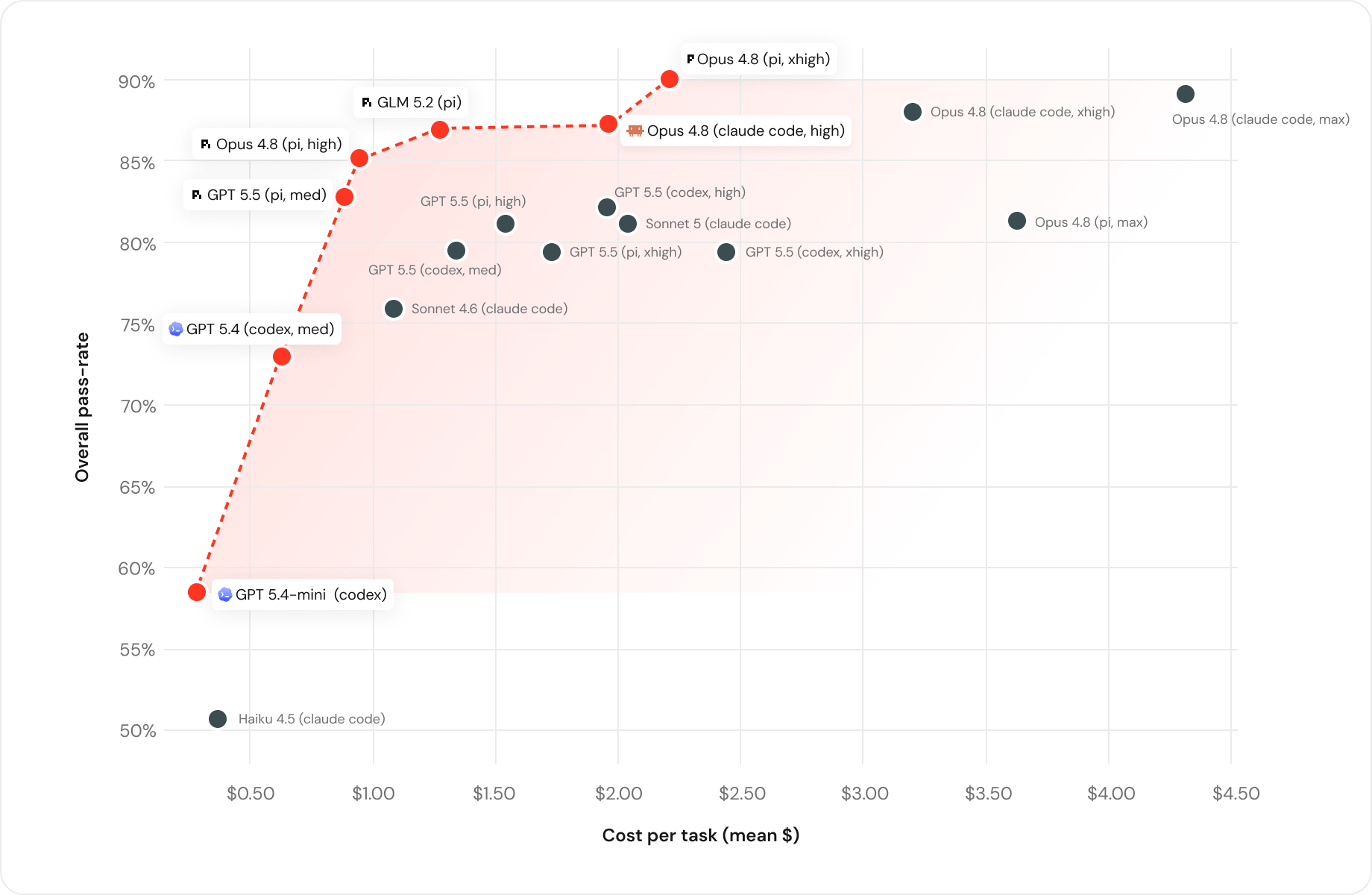
Their findings show a Pareto frontier that includes OpenAI, Anthropic, and open models. That alone is significant. Frontier coding performance is no longer a private two-company story. It is becoming a mixed ecology.
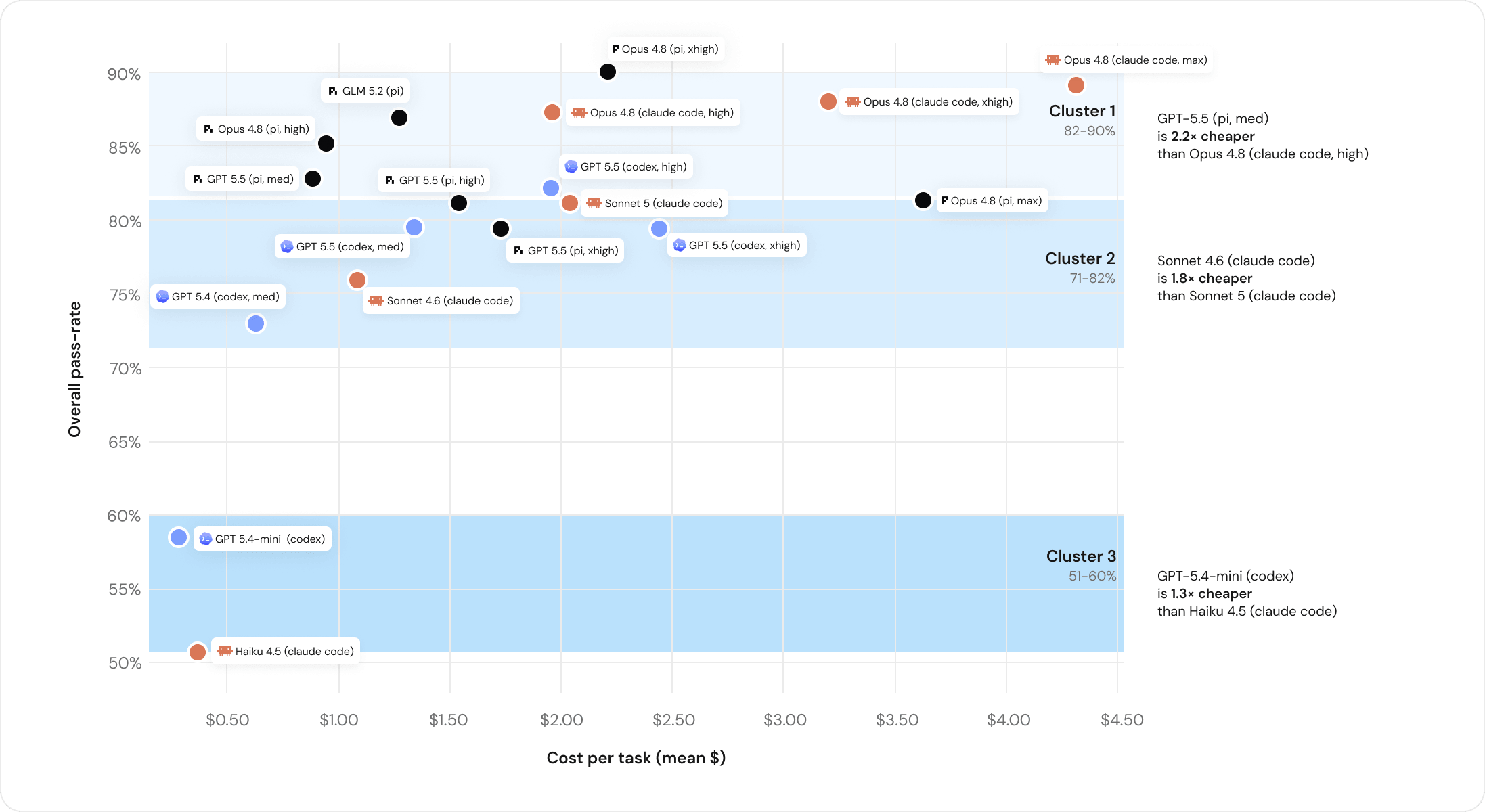
The benchmark also showed rough capability tiers. The top models are good across hard tasks, but they are expensive. Medium and smaller models can handle a lot of common work at much lower cost. That should change how engineering organizations deploy AI immediately.
Most companies still behave as if every task deserves the most expensive model they can access. That feels safe because the premium model is usually strong. It is also economically incoherent.
Not every task is a research problem.
Some work is changing a config. Some work is updating a test. Some work is tracing a simple bug. Some work is designing a migration path across three services without breaking the build.
This is where agentic software starts to look less like chat and more like operations. The important capability is not “which model do you like?” It is routing. It is knowing when to send the task to a cheap model, when to escalate to a frontier model, when to run three agents in parallel, when to ask a human for context, and when to stop because the test signal is not good enough.
The model is one part of the system.
The harness is the agent.
By harness, I mean the execution environment around the model: context selection, file access, tools, memory, permissions, shell commands, diff handling, tests, retries, branch management, and review loops.
Databricks found that the same model, with similar thinking effort, could have materially different cost and efficiency depending on the harness. In some cases, cost per task differed by more than 2x while quality stayed roughly the same.
That is not a footnote.
That is the product.
For the last year, everyone has been arguing about model intelligence. The Databricks benchmark says something more operational: intelligence without context discipline is expensive.
This is what every enterprise needs to internalize: the agent is the model plus the operating system around it.
Cost per Token is Broken
The benchmark also attacks one of the most common mistakes in AI budgeting: treating price per token as a proxy for price per task.
That frame is too tight and misses the full picture.
A cheaper model can become more expensive if it reads more, loops longer, retries poorly, drags in too much context, or fails often enough that humans have to repair the output. A more expensive model can be cheaper if it reaches the right answer quickly.
Databricks gave a clean example. Sonnet 5 was cheaper per token than Opus 4.8, but on their tasks it cost more per completed attempt while scoring lower. The reason was behavior. It consumed more tokens to get to a worse result.
This is the metric shift: do not ask what the model costs.
Ask what the completed task costs.
That is the number founders, CTOs, and operators should care about. If an agent fixes a bug, writes a migration, updates documentation, and passes the right tests, token line items are just ingredients. The unit that matters is the finished piece of work.
This is why every serious company will eventually build its own benchmark. Public benchmarks could not answer the question Databricks actually had, because Databricks does not run a public benchmark company. It runs Databricks. Its codebase, build graph, engineering patterns, and task distribution are the reality that matters.
That is true for every company.
If you have a backlog of merged PRs, you have the raw material for an internal agent benchmark. You can measure which tools solve your work. You can price them at the task level. You can see which models are overkill, which are underrated, and which harnesses quietly burn money by spraying context everywhere.
The companies that do this will compound.
The companies that do not will keep buying AI by brand.
GLM Is Bad News for American Models
The headline result is that GLM-5.2 landed in Databricks’ top capability tier. It was statistically tied with Opus 4.8 on quality in their benchmark, while costing less per task.
That is a big deal. Massive actually.
Not because one benchmark proves GLM is universally better. It does not. The honest read is narrower and stronger: on a serious internal coding benchmark from one of the most technically sophisticated software companies in the world, a lower-cost Chinese open model performed like a daily-driver coding model.
That is exactly the kind of evidence that changes buyer behavior.
In my piece, GLM-5.2 Proves AI Comes for All Moats I argued that GLM matters because it attacks the scarcity story underneath Western AI valuations. Premium labs need the market to believe frontier intelligence will remain scarce, expensive, proprietary, and defensible. They need “best model” to become “best business.”
GLM does not kill that argument, but it does compresses it.
If an open or open-ish Chinese model gets close enough on real coding work, the buyer’s question changes. It is no longer “who has the most prestigious model?” It becomes “why am I paying the frontier tax for this workload?”
Sometimes the answer will be good. Enterprises will still pay for trust, support, indemnity, governance, data controls, integrations, uptime, multimodal polish, and ecosystem maturity.
Premium models will still matter for the hardest work. But not every workload needs the sacred object.
And “not every workload” is where the economic damage begins.
If GLM can handle a meaningful share of coding tasks at lower cost, it does not need to beat OpenAI or Anthropic at everything. It just needs to be good enough on enough work to change the routing table.
That is how markets reprice.
Not all at once. Not with one dramatic replacement. Through thousands of small substitutions.
A config change goes to GLM. A test update goes to GLM. A medium bug fix goes to GLM. A migration plan starts with GLM, escalates to a premium model for design review, then returns to GLM for implementation attempts.
Suddenly the premium lab is not the default.
It is the escalation path.
That is a very different business.
Chinese Efficiency vs American Muscle
The uncomfortable American lesson is not just that Chinese models are catching up.
It is that they are catching up differently.
Western AI culture has been dominated by scale: more compute, bigger clusters, deeper capital pools, premium APIs, and a belief that the frontier can be held by whoever spends the most.
China has been forced into a different game. Sanctions, chip constraints, competitive pressure, and lower pricing power create a harsher environment. That environment rewards efficiency: architectural tricks, distillation, routing, context management, serving optimization, and ruthless price-performance thinking.
There are legitimate questions about Chinese labs that I’ve called out many times before. We know Chinese models benefit from Western outputs. Distillation and synthetic data are everywhere. There will be fights over originality, fairness, export controls, national security, and whether closed labs are funding the research that commoditizes their own products.
Those questions matter.
But they do not erase the market effect.
Customers buy outcomes. If a model solves the task, runs inside the workflow, can be self-hosted, and costs a fraction of the alternative, the origin story becomes secondary for many workloads. Not irrelevant. Secondary.
This is why GLM-5.2 showing up strongly in the Databricks benchmark matters more than a vendor leaderboard. Real-world internal evidence is harder to wave away.
It says the price-performance curve is moving into production reality.
That is the thing to watch.
Self-Hosted Frontier Models
The next phase is not just cheaper API calls.
The next phase is capable self-hosted models doing frontier-level work inside private systems. That changes the adoption curve. Many companies have not fully deployed coding agents because their code is sensitive, their compliance posture is strict, or their executives do not want proprietary source flowing through external systems.
Self-hosted capable models create a different option.
Now the company can run agents inside its own perimeter. It can inspect logs, constrain permissions, connect to internal systems, benchmark every model against its own repo, and run background agents against tech debt, flaky tests, dependency upgrades, security issues, documentation drift, and migration plans.
This is where the abundance shift becomes real.
When intelligence is expensive, you ration it. You use the premium agent for high-value work. You wait for the human to decide the task is worth spending tokens on. You keep the number of attempts low.
When intelligence is cheap and local, you stop asking whether a task deserves an agent.
You ask how many agents should try. You move from chatting to commanding a fleet of AI agents.

That changes software operations. Every issue can get a first-pass investigation. Every pull request can get multiple independent reviews. Every flaky test can get a background repair attempt. Every security advisory can be mapped against the actual codebase before a human opens the ticket.
This does not remove engineers.
It changes what engineering management is.
The bottleneck moves from typing code to designing work systems. The scarce skills become judgment, taste, architecture, review, evaluation, and the ability to define tasks clearly enough that agents can execute them.
This is why the Databricks methodology is so important. The benchmark is not just a report. It is a template for governing agentic labor.
Capture real work. Convert it into tasks. Hold back the answers. Test outcomes. Seal obvious leakage paths. Compare cost per task. Route accordingly. Repeat as models change.
That is the operating system.
Routing is Winning
In the model-scarcity world, the winner is whoever has access to the smartest model.
In the model-abundance world, the winner is whoever allocates intelligence best.
That means routers. Not just technical routers that send prompts to models based on cost and latency, though those matter. I mean organizational routers too: systems that decide which work should be automated, parallelized, escalated to a senior human, delegated to a cheaper model, or wrapped in a full audit trail.
The Databricks benchmark points directly toward this future. It does not say, “we found the one model everyone should use.” It says the frontier is a portfolio: a mix of tools, models, and harnesses, measured against real tasks.
That is the mature frame.
It also tells us where software companies should invest. Do not just buy seats. Build the measurement layer. Build the eval set. Build the model router. Build context discipline. Build permission boundaries. Build internal datasets from your own PRs. Build cost dashboards that show dollars per successful task, not just tokens per vendor.
The companies that get this right will not merely use AI. They will make AI legible.
And once intelligence becomes legible, it becomes manageable.
Once it becomes manageable, it becomes a line of operations.
The Moat Is Moving
The mistake is thinking this means moats disappear.
They do not.
They move.
The moat is less likely to be “we alone have the model.” That moat is getting shorter. Capability diffuses. Open models improve. Chinese labs optimize. Distillation compresses. Costs fall.
The new moats are closer to the work.
Who has the best proprietary evals? Who has the cleanest internal workflow data? Who can route tasks most efficiently? Who has the tightest harness? Who can make cheap intelligence reliable enough to trust?
That is better for builders and worse for anyone relying on scarcity premiums.
The Databricks benchmark is important because it makes this concrete. Coding agents are not a demo category anymore. They are an operating expense, a labor layer, and a routing problem. Open models are not just philosophical alternatives. They are entering the daily-driver conversation. The task, not the token, is the economic unit.
Most importantly, it shows that companies do not need to wait for the market to tell them what works.
They can measure it themselves.
That is the real frontier now.
Not a single model. Not a single lab. Not a single benchmark.
The frontier is the ability to convert cheap, abundant, increasingly local intelligence into reliable work.
GLM-5.2 is one signal. Databricks’ benchmark is another. Together they point in the same direction: the age of paying blindly for premium intelligence is ending. The age of managing intelligence as infrastructure is beginning.
And once self-hosted open models can do frontier-level work, the question stops being whether AI can help.
The question becomes whether your organization knows how to spend intelligence well.
Friends: in addition to the 17% discount for becoming annual paid members, we are excited to announce an additional 10% discount when paying with Bitcoin. Reach out to me, these discounts stack on top of each other!
Thank you for helping us accelerate Life in the Singularity by sharing.
I started Life in the Singularity in May 2023 to track all the accelerating changes in AI/ML, robotics, quantum computing and the rest of the technologies accelerating humanity forward into the future. I’m an investor in over a dozen technology companies and I needed a canvas to unfold and examine all the acceleration and breakthroughs across science and technology.
Our brilliant audience includes engineers and executives, incredible technologists, tons of investors, Fortune-500 board members and thousands of people who want to use technology to maximize the utility in their lives.
To help us continue our growth, would you please engage with this post and share us far and wide?! 🙏