
The Shift From Chat to Command

OpenAI just published one of the most important papers of the AI age, and it’s not a research paper about the next advance in technology… it’s focused on the economics of work as we enter the agentic age.
It’s massive not because it predicts the future.
Because it shows the future already forming inside the logs of the most advanced AI software in the world, used daily by millions.
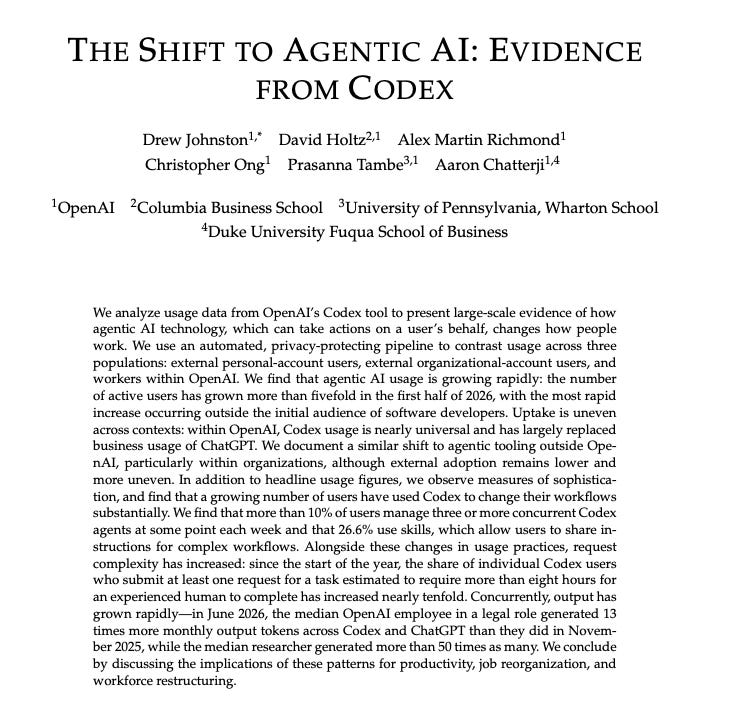
The paper, The Shift to Agentic AI: Evidence from Codex, studies how people are using Codex across individual users, organizational users, and OpenAI workers. The findings are not subtle. They show the exact moment AI stops being a chatbot and starts becoming a labor system.
This is the transition from asking to delegating.
This is the beginning of the agentic economy.
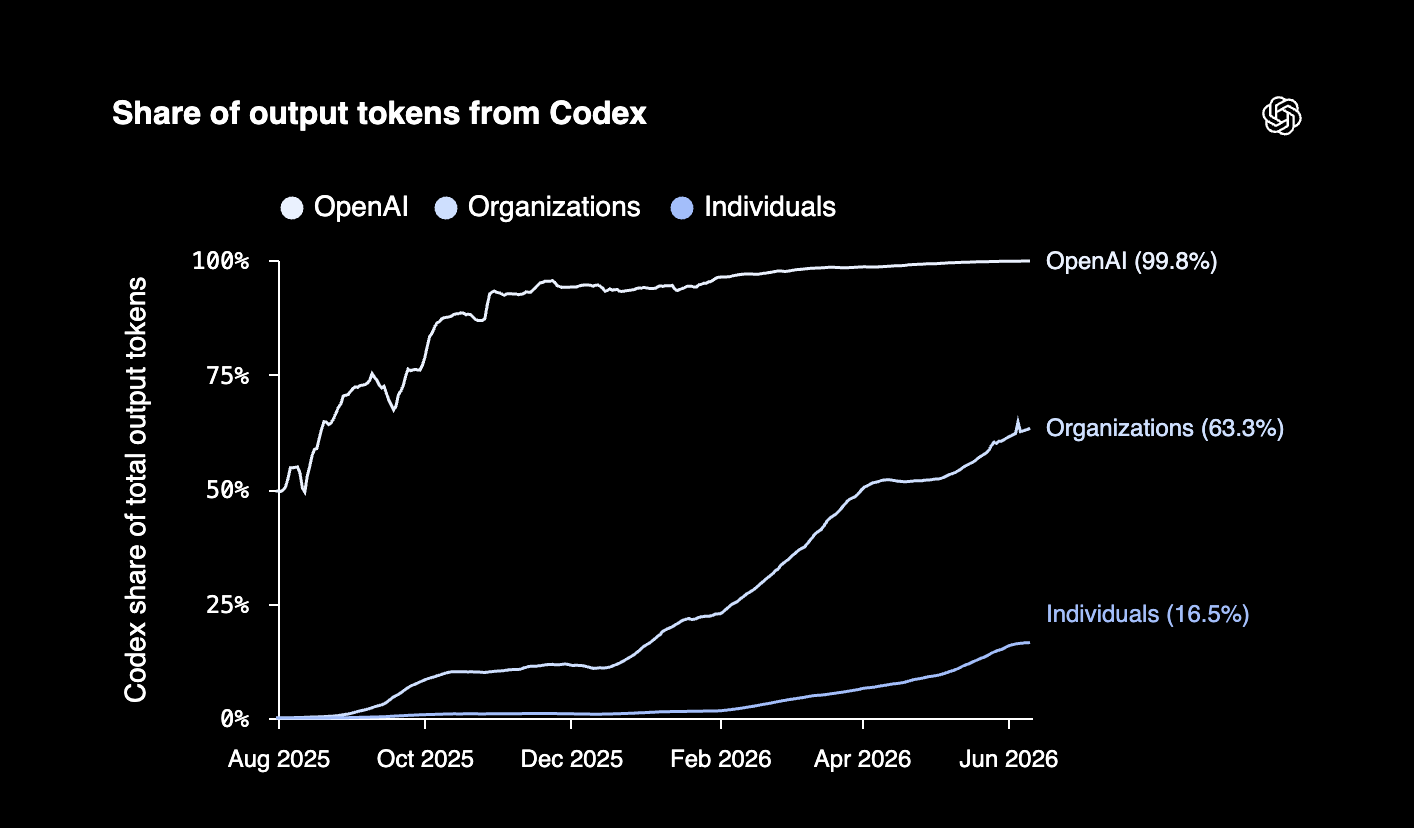
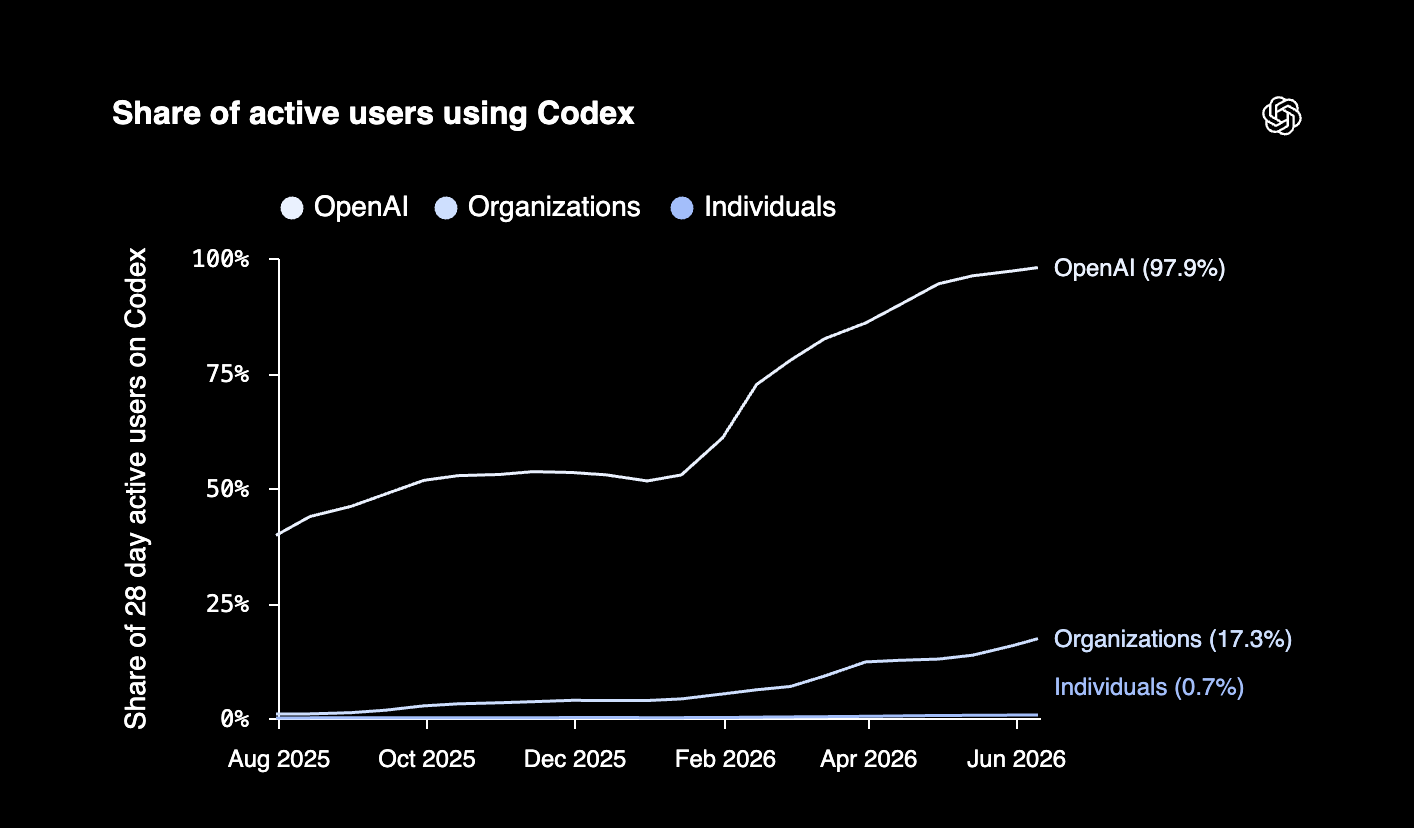
The most important number in the paper is not that active Codex users grew more than fivefold in the first half of 2026, although that alone is extraordinary. The important number is that among OpenAI workers, Codex now accounts for 99.8% of output tokens across Codex and ChatGPT. Organizational users are at 63.3%. Individual users are at 16.5%.
The frontier has already moved.
At OpenAI, the default interface for work is no longer conversation. It is delegation. The employee does not ask a model to explain a concept. The employee assigns a task, lets the agent inspect files, execute commands, modify artifacts, and return completed work.
That is an entirely different economic object.
A chatbot is a faster search bar. An agent is a junior worker with tools.
The old interface was question and answer. The new interface is command and execution. That distinction sounds small until you map it across every knowledge worker in the economy.
Then it becomes civilization-scale.
Software Is the First Battlefield
Codex begins in software because software is the perfect initial substrate for agentic AI.
Code is digital. Code is modular. Code can be tested. Code has clear artifacts. Code has logs, diffs, compilers, tests, repositories, issues, and deployment pipelines. The entire software production system is already machine-readable.
That means software is the first industry where cognitive labor can be fully wrapped in an agentic execution loop.
But the paper makes clear this is not staying inside software.
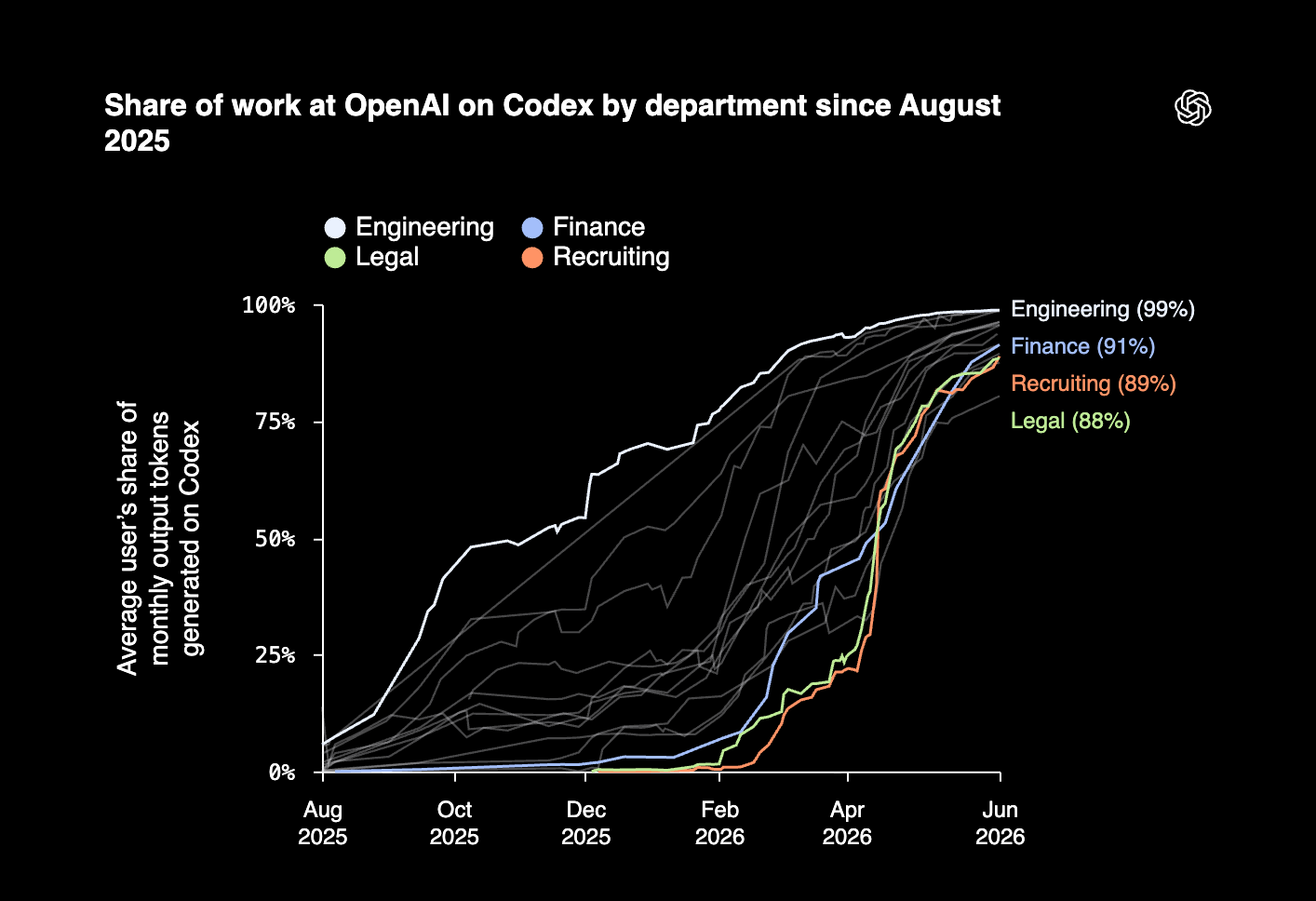
Codex users are already using it for documents, spreadsheets, memos, data analysis, research, collaboration, communication, planning, recruiting, sales, product work, and legal workflows. The paper repeatedly shows that the deepest adoption expands beyond the original developer base.
This matters.
The normal public narrative says coding agents are for engineers. That is wrong. Coding agents are the first visible form of a broader work agent. The developer is just the first professional whose daily labor is already close enough to executable text that the machine can absorb the workflow.
The same pattern will move outward.
First the agent writes code.
Then it maintains systems.
Then it reads company documents.
Then it drafts reports.
Then it updates spreadsheets.
Then it coordinates across Slack, email, CRM, calendar, data warehouse, and internal tools.
Then the human is no longer doing the work directly.
The human is directing the system that does the work.
This is why the paper’s distinction between conversational AI and agentic AI is so important. Conversational AI produces responses. Agentic AI produces outcomes.
Responses are information.
Outcomes are labor.
The Complexity Curve Is Moving Up
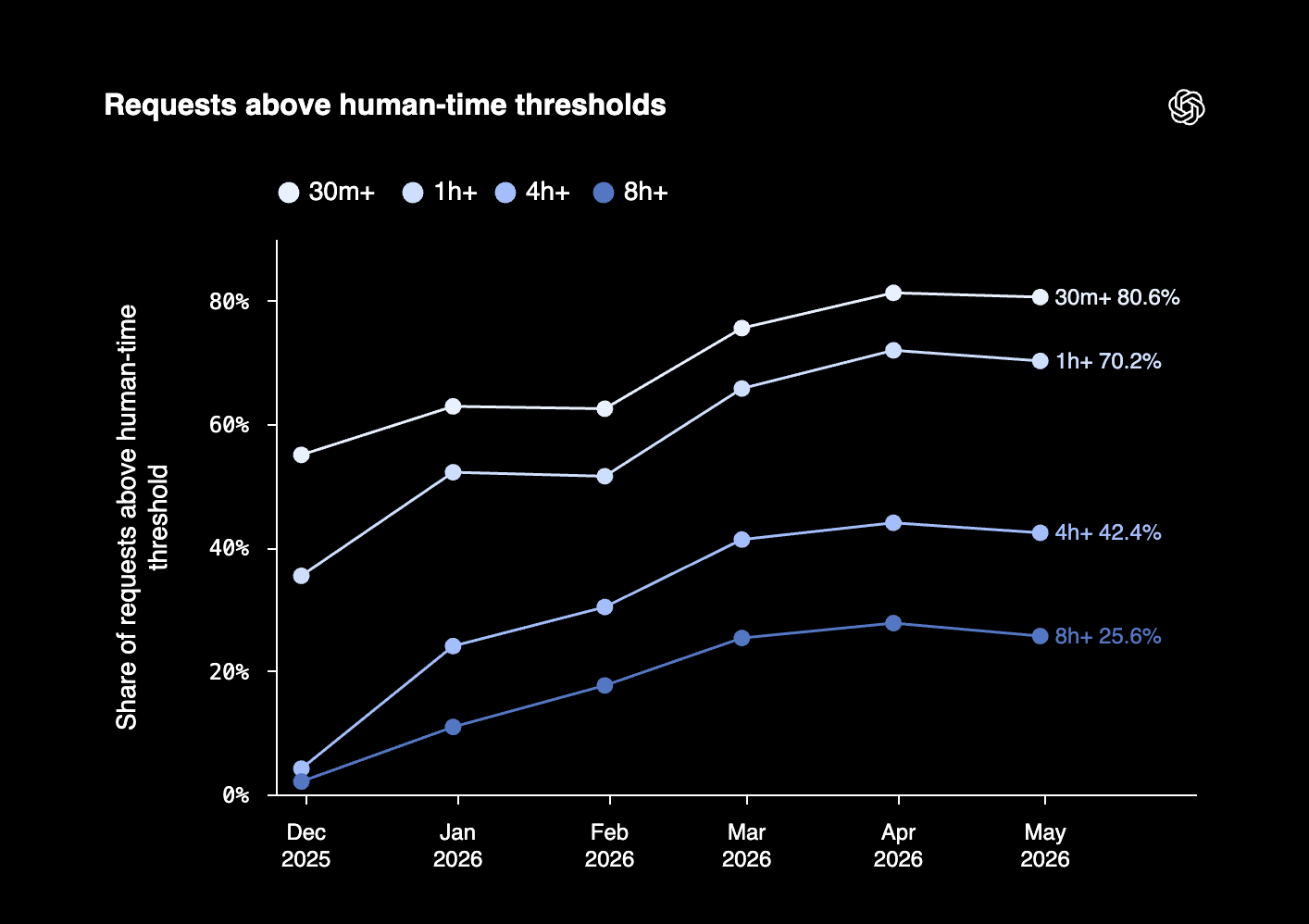
The most powerful section of the paper is about task complexity.
In December 2025, 35.4% of active individual Codex users sent at least one prompt estimated to require more than one hour of experienced human work. By May 2026, that number reached 70.2%.
Even more important: the share of users sending at least one request estimated to require more than eight hours of experienced human work rose from 2.1% to 25.6%.
Read that again.
A quarter of sampled individual Codex users were already handing off tasks that would take an experienced human more than a full workday.
This is not autocomplete.
This is not a productivity trick.
This is humans learning how to package larger blocks of work into machine-executable assignments.
The prompt is becoming the work order. The thread is becoming the workspace. The agent is becoming the production unit.
The paper also finds that the most complex requests tend to happen at the beginning of threads. That makes perfect sense. The human starts by delegating the broad mission. Then the follow-up turns become supervision, correction, refinement, and integration.
That is exactly how managers work with teams.
The initial instruction defines the objective.
The later interaction manages execution.
The human role is shifting up the abstraction stack.
The New Managerial Class
The most important worker in the agentic economy is not the person who knows the most facts.
It is the person who can design, delegate, verify, and integrate machine labor at scale.
The paper’s concurrency data makes this obvious.
Among individual and organizational users, most people are still using Codex in a relatively linear way. Roughly two-thirds of organizational and individual users did not run concurrent turns during the measured week.
But OpenAI workers are already operating differently.
Only 10.7% of OpenAI users ran a sole workflow at any one time. Nearly 28.6% managed five or more concurrent agents at some point during the measured period.
That is the new labor model.
One human. Multiple agents. Parallel execution. Continuous review.
This is not “using AI.”
This is managing an artificial workforce.
The highest-intensity users are already living in that world. The paper shows that the median OpenAI employee had Codex turns running for 2.5 hours on June 11, 2026. But at the 99th percentile, OpenAI employees ran about 71 hours of agent turns within the average day.
Seventy-one hours of work in one calendar day.
That is only possible when work becomes parallelized through autonomous execution.
A human cannot work 71 hours in a day. A human can manage systems that do.
That is the entire economic transition.
Skills Are the New Operating Procedures
The paper’s section on skills and plugins may be the most underappreciated part.
In Codex, skills allow users to encode reusable instructions, workflows, references, scripts, and procedural context. Plugins package capabilities and integrations. Together, they turn ad hoc prompting into repeatable production infrastructure.
That is the leap.
A prompt is temporary.
A skill is institutional memory.
A plugin is distribution.
The paper finds that skill use rose from 5.4% of active Codex users on March 1, 2026 to 26.6% on June 11, 2026. Among individual users, 25.7% invoked at least one skill in the measured week. Among organizational users, 30.4% did. Inside OpenAI, skill use was nearly universal at 96.2%.
This is exactly what should happen.
At first, people use agents manually. They type instructions over and over again. They paste context. They repeat preferences. They correct the same failure modes. They treat the agent like a clever external contractor.
Then the serious users systematize.
They write the operating procedure.
They attach the reference files.
They define the review loop.
They standardize the workflow.
They turn repeated human judgment into reusable machine context.
That is where leverage compounds.
The agent itself is powerful. But the agent connected to persistent procedural memory is far more powerful. The organization that captures its workflows into reusable skills will accelerate. The organization that leaves everything inside scattered chats will drown in its own friction.
This is why the next competitive moat is not just model access.
Everyone will get model access.
The moat is workflow architecture.
The moat is proprietary data.
The moat is captured context.
The moat is knowing how your organization actually works and encoding that into systems agents can execute.
Not Created Equal
The authors are appropriately careful. They note that OpenAI is not a normal organization. Workers there are closer to the frontier, usage is cheap at the margin, training and informal knowledge sharing are common, and the culture is already oriented around these tools.
That caveat is correct.
It is also the entire point.
OpenAI is not just the average firm. OpenAI is the preview environment.
What happens inside OpenAI in 2026 happens inside aggressive technology companies next. Then financial firms. Then professional services. Then media. Then logistics. Then healthcare administration. Then government operations. Then education.
The delay is not capability.
The delay is organizational digestion.
Most companies are still structured around human bottlenecks. Meetings. Approvals. Hand-offs. Status updates. Permission layers. Fragile processes hidden inside people’s heads. These systems were designed for a world where labor was scarce, communication was slow, and execution required humans moving one task at a time.
That world is ending.
The paper shows that when friction drops, work reorganizes around agents very quickly. At OpenAI, Codex became dominant across functions, not just engineering. Legal, recruiting, research, product, communication, and data workflows all moved toward agentic execution.
This is the pattern every serious organization should study.
The question is not whether your employees will use AI.
The question is whether your company can restructure work fast enough to absorb agentic labor.
Human Capital Is Being Repriced
The value of raw execution is falling.
The value of judgment is rising.
The value of system design is rising.
The value of verification is rising.
The value of taste is rising.
The value of proprietary context is rising.
The value of being able to coordinate ten parallel streams of machine work without losing the plot is rising dramatically.
This is the new human capital stack.
In the old economy, workers were paid for performing tasks. In the agentic economy, workers are paid for defining objectives, designing systems, supplying context, judging outputs, and integrating results into reality.
That sounds abstract. It isn’t.
A lawyer who can supervise five legal research agents, review their work, synthesize the answer, and produce a client-ready memo will outperform the lawyer still manually searching documents.
A founder who can deploy agents across product, sales, research, support, finance, and operations will outperform a legacy team waiting for weekly meetings.
An investor who can run continuous diligence agents across filings, technical documents, market data, customer signals, and founder history will outperform the analyst still building static spreadsheets.
A writer who can operate research, editing, distribution, image, and audience-analysis agents will outperform the writer staring at a blank page.
The individual systems architect becomes a company.
The company that fails to become a system becomes obsolete.
What To Do Now
The practical mandate is straightforward.
Audit every workflow you touch.
Find the repeated tasks.
Find the tasks with clear inputs and outputs.
Find the tasks where context is scattered but knowable.
Find the tasks that require data collection, transformation, drafting, comparison, review, or coordination.
Then turn those workflows into agentic systems.
Do not merely “use AI more.” That is vague and weak.
Build the loop. Write the instructions. Attach the references. Capture the data. Create review checkpoints. Measure output. Improve the workflow.
Repeat until the system becomes faster than the human process it replaced.
This is how you compound.
The people who win will not be the people who occasionally ask ChatGPT for advice. The people who win will be the people who convert their daily work into repeatable agentic infrastructure.
The paper gives us the empirical map.
Agentic adoption starts unevenly.
Technical workers move first.
Non-technical workers follow.
Task complexity rises.
Concurrency rises.
Skill use rises.
Output explodes.
The human moves from operator to orchestrator.
That is path of the singularity.
The Frontier Has Already Crossed
The shift from conversational AI to agentic AI is not a product update.
It is a labor-market phase change.
The chatbot era taught humans to ask better questions. The agent era teaches humans to assign better work.
That is a much bigger transition.
OpenAI’s Codex paper shows the early shape of this world with data instead of speculation. The frontier users are not just chatting more. They are delegating larger tasks, running agents in parallel, reusing codified workflows, and reorganizing their own effort around supervision and integration.
This is how the next economy gets built.
Not by replacing every human overnight.
By turning every high-agency human into the manager of a growing machine workforce.
The leverage curve is bending upward.
The only serious response is to build systems that bend with it!
Friends: in addition to the 17% discount for becoming annual paid members, we are excited to announce an additional 10% discount when paying with Bitcoin. Reach out to me, these discounts stack on top of each other!
Thank you for helping us accelerate Life in the Singularity by sharing.
I started Life in the Singularity in May 2023 to track all the accelerating changes in AI/ML, robotics, quantum computing and the rest of the technologies accelerating humanity forward into the future. I’m an investor in over a dozen technology companies and I needed a canvas to unfold and examine all the acceleration and breakthroughs across science and technology.
Our brilliant audience includes engineers and executives, incredible technologists, tons of investors, Fortune-500 board members and thousands of people who want to use technology to maximize the utility in their lives.
To help us continue our growth, would you please engage with this post and share us far and wide?! 🙏