
The Top 5 Metrics to Measure Agents

We are living through an existential shift.
The old rules of software are dead. The API economy is dead.
We are entering the age of the autonomous vector.
You are either building the system, or you are being ground down by it. There is no middle ground.
We were told generative AI was about creativity. We were told it was a conversational co-pilot to make our workflows slightly faster. And for a long time, that worked. People built cute wrappers and called themselves founders.
But here is the hard truth.
Co-pilots are for amateurs. Conversational AI is a toy.
On the surface we are building auto-pilots called agents. Really, we are building engines of infinite leverage.
An AI agent is not a chatbot. It is a piston in your operational engine. It is a mechanized worker that operates flawlessly at the speed of compute. It is a biological organism encoded in silicon, designed to consume raw data and excrete pure ROI.
If you treat an agent like a software tool, it will fail. You must treat it like a system.
And to master the system, you must measure the torque. You must measure the friction. You must measure the leverage.
The legacy metrics of Silicon Valley (Daily Active Users, Pageviews, Latency) are traps. They measure human attention.
We do not care about human attention. We care about machine execution.
Stop measuring vanity. Measure survival. Measure velocity. Measure the system.
Here are the only five metrics that matter when measuring the performance of an AI Agent.
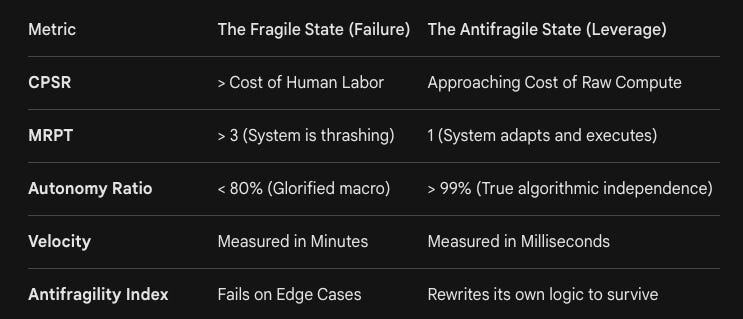
Now, let’s walk through each one and explain why they matter so much.
1. Cost Per Successful Run (CPSR)
This is the ultimate measure of your agent’s financial leverage.
Every time your agent fires, it burns fuel. It burns API tokens. It burns compute. It burns server time.
If your agent fails to achieve its objective, that fuel is wasted. It is friction in the system.
Most engineers measure the cost of the LLM call. That is a trap.
The cost of a single call is irrelevant. The only thing that matters is the aggregate cost to drive the piston all the way down and complete the task.
CPSR forces you to face the reality of your unit economics.
It is the cost of compute.
It is the cost of latency.
It is the cost of failure.
If your agent costs $0.05 per API call, but it hallucinates, loops, and requires 20 calls to finish a data extraction task, your real cost is $1.00.
If a human can do it for $0.50, your system is not providing leverage. It is a liability.
You calculate the financial torque of your system using this exact formula:

If this number is not strictly decreasing week over week, your system is decaying.
Drive the cost down. Increase the torque.
Achieve infinite leverage.
2. Median Retries Per Task (MRPT)
Execution requires ruthlessness.
When you give an agent an objective, it must execute. But agents operate in chaotic environments. APIs fail. Websites change their DOM structure. Prompts are misinterpreted.
When the agent fails, it must retry.
We were told AI hallucination was the fatal flaw. We were told to fear the model making things up. And for a long time, that dominated the discourse.
But here is the hard truth.
Retries are the real silent killer.
A retry is an engine misfire. It is gears slipping. It is pure, unadulterated friction.
You do not look at the average. Averages are easily skewed by a single catastrophic loop where an agent retries 500 times.
You look at the median.
Median Retries Per Task (MRPT) tells you exactly how much friction exists in your core system architecture.
If your MRPT is 0, your agent is a brittle script operating in a perfectly sterile environment. It will shatter the moment it faces reality.
If your MRPT is > 3, your agent is incompetent. The system is thrashing.
You want an MRPT of .5 to 1.
It means the agent hits an obstacle, recognizes the failure, re-calibrates its vector, and succeeds on the second attempt.
That is adaptation. That is extreme ownership of the task.
Measure the friction. Optimize the prompt.
Reduce the slippage.
3. The Autonomy Ratio (Human Intervention Rate)
A system that requires human intervention is not an autonomous system. It’s a glorified macro.
Every time a human has to step in to fix a stuck agent, approve a workflow, or decipher an error log, your leverage collapses back to zero. You have become the bottleneck in your own machine.
The Autonomy Ratio measures the percentage of tasks the system completes from end-to-end without a single biological input.
It is the ability to plan.
It is the ability to execute.
It is the ability to verify.
If you deploy a swarm of customer service agents, and 30% of their tickets must be escalated to a human manager because the agent lacks the contextual awareness to solve it, your Autonomy Ratio is 70%.
That is a failure of system design.
To survive the Singularity, you must build systems that manage themselves.
Stop coddling the algorithm.
If the agent cannot close the loop, rewrite the stack. Give it access to better tools. Give it a memory vector database.
Demand extreme ownership from the silicon. Push the Autonomy Ratio toward 99.999999%.
Let the machine run.
4. Velocity of Execution (Time-to-Impact)
Speed is a scalar. Velocity is a vector.
Speed is how fast your LLM streams tokens. Velocity is how fast your agent alters reality.
The market does not care how fast your model generates text. The market cares how quickly your system can scrape a competitor’s pricing, analyze the delta, rewrite your own pricing matrix, and push the update to your production database.
Velocity of Execution measures the time elapsed between the trigger and the impact.
This metric exposes the bloated silos in your architecture.
If your LLM is lightning fast, but your agent takes 45 seconds to parse a JSON file because your parsing logic is inefficient, your velocity is pathetic.
The enemy is latency.
Every millisecond of delay is an opportunity for your competitor’s system to out-position yours. Sun Tzu said, “Let your rapidity be that of the wind.” In the agentic era, your rapidity must be that of fiber optics.
Measure the vector. Optimize the pipeline. Strip away the dead weight.
5. The Antifragility Index (Edge Case Survival)
Most software is fragile. When it encounters an input it wasn’t programmed for, it breaks. It throws a 500 error. It stops.
Agents must be different. Agents must be antifragile.
Nassim Taleb taught us that the robust resists shocks and stays the same, but the antifragile gets better.
The Antifragility Index measures how your agent responds to unprecedented chaos.
When an API endpoint completely changes its schema, what does the agent do?
Does it crash? (Fragile)
Does it pause and alert a human? (Robust)
Does it search the web for the new API documentation, read the schema, rewrite its own integration code, test it, and successfully complete the task? (Antifragile)
This is the ultimate test of the system.
You measure this by deliberately injecting chaos into your staging environments. You break the APIs. You scramble the data. You observe the system’s ability to heal itself.
If your agent cannot survive the chaos, it will not survive the market.
Build systems that consume volatility as fuel.
Build systems that gain torque from friction.
We are building the engines of the future. The humans who understand how to measure, optimize, and deploy these autonomous vectors will achieve wealth and leverage incomprehensible to the previous generation.
Subscribe to Wealth Systems to learn more about leveraging these systems for building wealth.

Friends: in addition to the 17% discount for becoming annual paid members, we are excited to announce an additional 10% discount when paying with Bitcoin. Reach out to me, these discounts stack on top of each other!
Thank you for helping us accelerate Life in the Singularity by sharing.
I started Life in the Singularity in May 2023 to track all the accelerating changes in AI/ML, robotics, quantum computing and the rest of the technologies accelerating humanity forward into the future. I’m an investor in over a dozen technology companies and I needed a canvas to unfold and examine all the acceleration and breakthroughs across science and technology.
Our brilliant audience includes engineers and executives, incredible technologists, tons of investors, Fortune-500 board members and thousands of people who want to use technology to maximize the utility in their lives.
To help us continue our growth, would you please engage with this post and share us far and wide?! 🙏