
The Roadmap to AGI
From Pattern Matching to True Comprehension

We are on the road to creating magic: AGI.
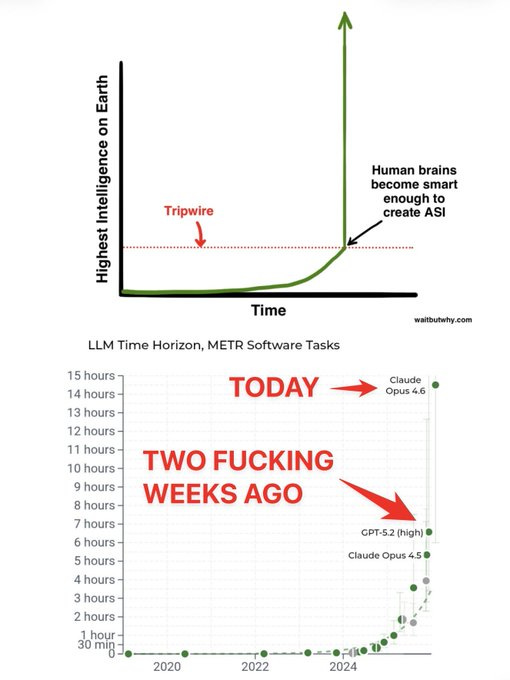
This chart is one of the most important in the world. It illustrates a metric called the “Time Horizon” for Large Language Models when tackling complex software engineering tasks. Specifically, it tracks how long an AI can work autonomously on a problem before its performance or reliability breaks down.
In just two weeks, AI gained the ability to work for 7-hrs non-stop at the speed of light (before context failure and performance dropped off).. to being able to work for 15 hours.
We are transitioning from AI as a "search engine for code" to AI as a "synthetic employee." If a model can stay on track for 15 hours, it can complete entire features or refactor entire repositories overnight.
A 15-hour time horizon means one developer could potentially oversee a dozen AI agents, each doing the work of a junior-to-mid-level engineer. This significantly lowers the cost of software production.
Carry that curve forward in your mind and imagine how long our agents are going to be able to plan & work on a project by this Fall.. or next Summer?
If the trend continues, we will see models with "week-long" and "month-long" horizons by 2027.
While impressive, the current AI we use is not AGI.
They are an engine of probabilistic mathematics.
The scores are incredible but you must stop anthropomorphizing the code. You must kill the delusion that human intellect is a sacred, untouchable fortress.
It is not.
It is an organic algorithm. The finest engineering in the known universe…
And right now, we are building a synthetic one to replace it. We are using AI itself to build AI.. at accelerating rates.
This is not a philosophical exercise. This is a matter of absolute survival. The global economy is a battlefield. The topography of that battlefield is shifting beneath your feet.
If you do not understand the mechanics of the machine that is being built, you will be crushed under its treads. You will be obsolete. You will be a casualty of the transition.
We are hunting AGI: Artificial General Intelligence. We mean to enter the singularity.
The media paints AGI as a sentient robot, a sci-fi terminator with a consciousness. That is a distraction. Bad theater.
AGI is a mechanical definition. It is a system capable of matching or exceeding human performance across any economically valuable cognitive task.
Narrow AI is a torque wrench. It is optimized for a single, isolated domain. It plays chess. It folds proteins. It does one thing, and it does it with brutal efficiency.
But AGI is the entire cognitive manufacturing plant.
It’s the ability to design the wrench, build the wrench, and restructure the supply chain that ships the wrench.
This race is the most heavily capitalized, ferociously contested technological sprint in the history of human civilization. The stakes are existential. The nation or corporation that achieves AGI first does not just win a market. They win leverage over reality itself.
Let’s lift the hood. Let’s look at the engine.
Where We Are Now: The Baseline of 2026
We are not at the finish line. But we are moving at blinding speed.
Look at the current frontier models. Gemini 3.1 Pro. GPT-5. Grok Heavy.
They are multimodal beasts.
We gave the engine eyes to see.
We gave the engine ears to hear.
We gave the engine a voice to speak.
We were told these machines understood us. And for a long time, looking at their outputs, that illusion seemed real.
But here is the hard truth.
Current Large Language Models do not comprehend. They predict. They run on autoregressive generation. They look at the sequence of tokens (the sequence of gears in the transmission) and calculate the mathematical probability of the next gear turning.
Sounding intelligent is not the same as being intelligent. I’m sure you’ve met a person or two that taught you that lesson.
A parrot in a wind tunnel might mimic an aerodynamicist, but it does not understand aerodynamics.
To measure the distance to the horizon, the industry uses a mechanical framework.
OpenAI defined five levels of the AGI combustion cycle:
Level 1: Chatbots. Conversational AI. The engine idles. It talks. We conquered this. This is the past.
Level 2: Reasoners. Systems capable of basic, localized problem-solving. The engine engages first gear. This is where we are currently redlining.
Level 3: Agents. Systems that can take autonomous action over multiple days. The engine drives itself to the destination. This is the cutting edge.
Level 4: Innovators. Systems that can invent novel scientific breakthroughs. The engine redesigns its own fuel source. This is next.
Level 5: Organizations. Systems capable of executing the operational load of an entire human institution. The engine is the economy. This is
We are pushing against the friction of Level 2 and are trying to get our footing in Level 3.
To get to Level 5, the machine must evolve.
The Foundational Milestones: What AI Must Gain
If we want the ultimate engine, we can’t just add more fuel.
We need to redesign the machine.
Here is what the system must gain.
1. System 2 Thinking (Metacognition)
Right now, the machine operates on System 1. It is fast. It is intuitive. It fires the spark plug immediately. And because it fires so fast, it hallucinates. It confidently produces catastrophic failure.
The engine needs a clutch. It needs System 2.
It is the ability to pause.
It is the ability to deliberate.
It is the ability to allocate “test-time compute” to simulate multiple paths before choosing the optimal vector.
2. Continual Learning
Your biological brain is an engine of neuroplasticity. You learn a new skill without forgetting your own name.
The machine suffers from “catastrophic forgetting.” When you retrain the neural network on new data, the old weights are overwritten. The gears are stripped.
AGI requires real-time episodic memory. It must update its internal model on the fly, without requiring a hundred-million-dollar retraining run just to remember what happened yesterday.
3. Causal Reasoning
This is the critical failure point of current systems.
Current AI understands correlation. It understands the probability of Y given X. It knows that when it rains, people carry umbrellas.
But it does not understand causation. It does not fully understand the probability of Y if we intervene and do X.
It doesn’t know that giving everyone an umbrella will not cause it to rain.
AGI must cross the bridge from observing the world to understanding the physics of the world.
The Proposed Pathways: How Do We Actually Build It?
The blueprints for AGI are actively being contested by the smartest engineers on earth. There is no consensus. There is only a brutal, high-stakes competition of architectures.
Let’s review the top contenders and the folks making the most noise.
Approach A: Scale + Scaffolding
This is the brute-force method. Build a bigger combustion chamber. Pump in more data. Apply massive compute. Wrap the LLM in “agentic” scaffolding comprised of external memory banks and recursive loops. The bet here is that quantity has a quality all its own. Scale until the spark of reasoning ignites by sheer mathematical pressure.
Approach B: Neuro-Symbolic AI
Neural networks are messy. They are probabilistic. They guess.
Traditional “symbolic” AI is rigid. It is logical. It operates on strict rules.
The hybrid path marries the two. It uses the neural network for pattern recognition (vision, hearing) and the symbolic engine for factual logic and deduction.
Many have tried (and failed) here. However folks are now marrying modern LLMs with symbol engines and seeing powerful results. Everything old has a habit of becoming new again.
Approach C: Cognitive Architectures
This school stops treating the machine as a black box and builds it like a human brain, instead. They hard-code specific modules for working memory, long-term memory, emotional regulation, and goal-setting. This structures the system based on evolutionary psychology and human cognitive theory.
Approach D: Neuromorphic Computing (The Hardware Path)
Software is not enough. The bottleneck is the silicon.
Standard Von Neumann architecture separates processing and memory. That creates latency. That creates heat. Neuromorphic engineering demands completely new physical microchips. Imagine silicon (or another substrate) that biologically mimics human synapses, processing and storing data in the same physical space.
This is like building power generation (nuclear reactors) atop high-performance computing centers… you save money on transmission wires and get better performance.
How Will We Know When We Arrive?
The old metrics are dead.
The Turing Test is a parlor trick. It measures human gullibility, not machine intelligence.
Human-designed exams (the SAT, the Bar Exam, the USMLE) are useless. The machine has already ingested the answers in its training data. Passing the test is not proof of reasoning; it is proof of a hard drive and decent search function.
We need stress tests for the engine.
1. The ARC-AGI Benchmark
The Abstraction and Reasoning Corpus.
This is the crucible. It strips away language. It presents the machine with entirely novel, visual logic puzzles it has never seen before. It tests the system’s ability to learn out-of-distribution skills with minimal examples. Current LLMs fail miserably here. It is the ultimate test of adaptability.
2. The “Coffee Test” (Steve Wozniak)
Forget the digital realm. Bring the machine into reality.
Can a robotic agent enter an unfamiliar, unstructured human home? Can it locate the kitchen? Can it open the cabinets, identify the coffee beans, find the water source, operate the grinder, and successfully brew a cup of coffee without a single line of pre-programmed human intervention?
When the machine can do that, the war is won.
I favor Demis Hassabis’ definition of AGI:
The Great Roadblocks
The march to AGI is not inevitable. There are physical limits. There is friction in the system.
The Data Wall
Data is the fuel. And the reserves are running dry.
We have exhausted the high-quality text on the public internet. The machine has read everything. Now, engineers are feeding AI data generated by other AI known as ”synthetic data.”
But there is a trap. If you train an engine purely on its own exhaust, you suffer model collapse. The machine amplifies its own errors until the outputs become degenerate noise.
The engine chokes on its own fumes.
The Energy and Compute Crisis
Intelligence requires thermodynamics.
Your human brain is an absolute marvel of biological engineering. It runs on roughly 20 watts of power.
To train a frontier AI model, we are building data centers that consume hundreds of megawatts. We are talking about grid-level power. Nuclear reactors dedicated to single server farms. Matching the 20-watt efficiency of the biological engine with silicon hardware is a monumental, perhaps impossible, physics challenge.
If we run out of power, the engine stops.
Conclusion: Timeline
When does it happen?
I say: AGI by the end of 2027, potentially as early as Spring 2027.
Now let’s look at the expert consensus. The aggressive timelines predict AGI by 2028. The conservative models push it past 2040.
The exact date does not matter anymore.
The trajectory is set and we have too much inertia to stop before AGI arrives.
But understand this: AGI will not arrive like a lightning strike on a random Tuesday. You will not wake up to an alert that the world has changed overnight.
It is an iterative transition. A relentless, grinding evolution of capability. A never-ending sunrise.

Let’s look at the horizon.
The fear-mongers want you paralyzed. They sell a narrative of doom. They picture the machine replacing the man. They want you terrified of the algorithm.
That is a victim’s mindset.
Here is the objective reality. AGI is not the end of human utility. It is the birth of peak human leverage.
For ten thousand years, we fought friction.
We fought scarcity.
We fought the hard limits of our biology.
We used muscle. Then we used steam. Then we used silicon.
AGI is simply the ultimate gear in the transmission. It is not an overlord. It is an exoskeleton for the human mind.
Think about the torque this engine generates.
Imagine a doctor wielding the diagnostic throughput of a thousand research hospitals, isolating and curing cellular decay. Imagine an engineer simulating a million nuclear-fusion prototypes in the time it takes to exhale, permanently solving the global energy crisis. Imagine a single, high-agency individual commanding the logistical firepower of a massive corporation straight from their kitchen table.
We are not building our replacements. We are constructing an engine of infinite abundance.
The friction of the modern economy will be incinerated. The administrative bloat, the rote memorization, the endless data entry… that is all low-level computational exhaust.
The machine will absorb it.
We were told that work meant suffering through the mundane. And for a century of industrialization, that was true.
But here is the reality: when the machine handles the execution, the human is finally free to handle the strategic master vision.
The premium on raw creativity will skyrocket. The premium on complex problem-solving will compound. The premium on bold, unadulterated human ambition will become the single most valuable asset class on the planet.
The exact timeline does not matter. The trajectory is what counts.
The transition will be volatile. Evolution always is. But the organism that adapts, survives. The organism that aggressively leverages the new environment, conquers.
Look at the machine. Do not shrink from it. Master its mechanics.
You are not a casualty of the future. You are the architect of it.
Build your competence. Build your resilience. Build your sovereign fortress.
The era of human limits is closing. The era of the augmented human is throttling up.
Grab the controls. Fire the engine. Dominate the new terrain.
You made it to the singularity. You made it to the good part.
Thank you for helping us accelerate Life in the Singularity by sharing.
I started Life in the Singularity in May 2023 to track all the accelerating changes in AI/ML, robotics, quantum computing and the rest of the technologies accelerating humanity forward into the future. I’m an investor in over a dozen technology companies and I needed a canvas to unfold and examine all the acceleration and breakthroughs across science and technology.
Our brilliant audience includes engineers and executives, incredible technologists, tons of investors, Fortune-500 board members and thousands of people who want to use technology to maximize the utility in their lives.
To help us continue our growth, would you please engage with this post and share us far and wide?! 🙏