

OpenAI tripled an AI agent’s benchmark score by changing two settings. The result reveals why the next leap in AI will come from systems that remember, learn, and make better use of every watt.
This piece ends with 3 bold predictions for the next 12-months that you don’t want to miss if you are an investor, or if you are building something.
Sometimes a small technical change reveals the whole shape of the future.
OpenAI recently tested GPT-5.6 Sol on ARC-AGI-3, a benchmark built from unfamiliar 2D puzzle games. The model must explore each game, infer its rules, and improve through action without being told how the game works.
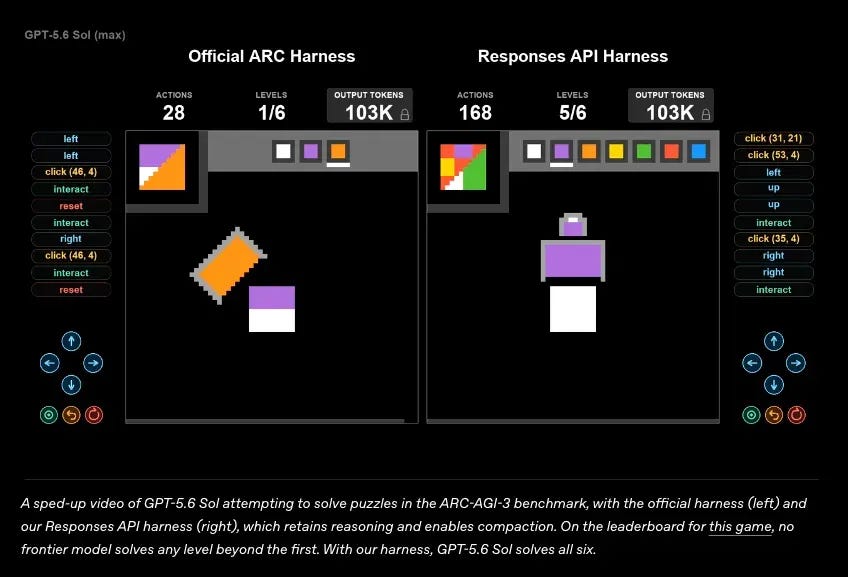
Using the official benchmark harness, GPT-5.6 Sol scored 13.3% on the public task set. OpenAI then changed two settings. It retained the model’s reasoning between actions and replaced rolling context truncation with compaction.
The score rose to 38.3%.
At the same time, output tokens per game fell from roughly 2.9 million to 485,000.
The same model produced nearly three times the score with about one-sixth of the output.
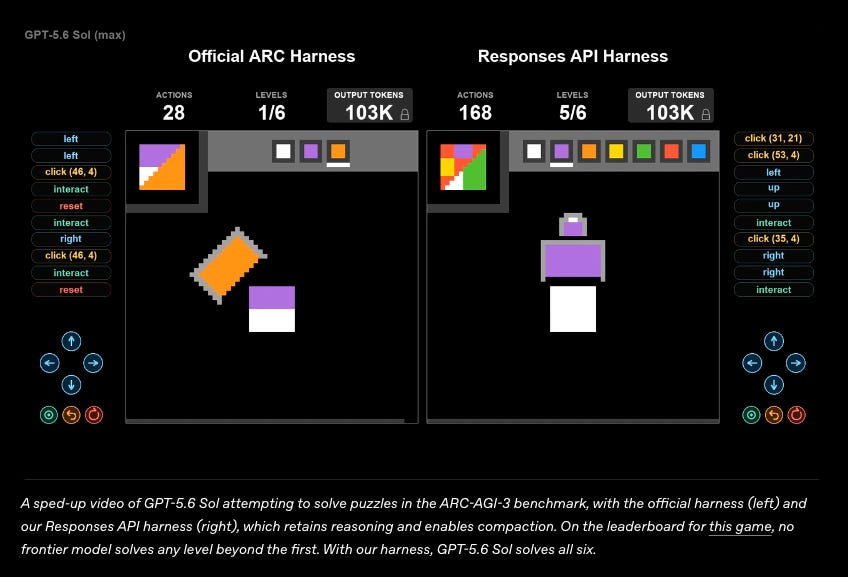
The weights did not change. The training run did not change. The games did not change.
The system around the model changed.
That is the story.
In Agents Per Gigawatt, I argued that the decisive economic metric of the AI era will be how much useful machine labor we can produce from energy. In Scientific Time Dilation, I argued that persistent AI systems will compress discovery by running more scientific work in parallel and feeding each result into the next attempt.
OpenAI’s ARC-AGI-3 experiment connects those two ideas.
Agents per gigawatt is about how much cognition a system can afford to run.
Scientific time dilation is about whether that cognition compounds.
The harness determines both.
The Model Is Not the System
“The same model produced nearly three times the score with about one-sixth of the output.”
We all still talk about AI capability as if it lives entirely inside the model.
A new model is released. A benchmark score goes up. A parameter count leaks. A training cluster grows. We compare one set of weights against another and treat the result as a clean measurement of intelligence.
But a model is not an agent any more than an engine is a car.
The model supplies the reasoning capacity. The surrounding system supplies memory, context, tools, permissions, feedback, and continuity. It decides what the model can see, what it can do, what it remembers, when it retries, and whether a useful lesson survives long enough to shape the next action.
That surrounding system is the harness.
We wrote in Agents Per Gigawatt that the harness is the agent. OpenAI has now given us one of the cleanest demonstrations of that claim.
The official ARC-AGI-3 harness was intentionally generic. That makes sense from the benchmark designer’s perspective. A common interface can make comparisons cleaner and expose what a model can do without a stack of custom tools.
But generic does not mean neutral.
In the official setup, the model’s private reasoning was discarded after each game action. GPT-5.6 Sol could see previous moves and brief notes, but it could not see the thinking that produced them. It had to reconstruct its understanding of the game again and again.
The harness also used a rolling truncation window. Once the history grew too large, the oldest actions disappeared. The agent lost not only its prior reasoning, but eventually parts of its experience.
Imagine evaluating a human by wiping their working memory after every move and tearing pages from their notebook whenever it became too thick.
You would not be measuring the person in isolation. You would be measuring the person inside an amnesia machine.
The same problem applies to agents.
Intelligence Needs Continuity
A single response can be impressive without memory. A long task cannot.
Long-horizon work depends on continuity. The system must remember what it tried, why it tried it, what happened, which assumptions failed, what patterns emerged, and what the current plan is. Without that chain, every new action begins too close to zero.
This is why retained reasoning mattered.
When GPT-5.6 Sol could carry its prior thinking forward, it no longer had to reinterpret the game from scratch after each action. It spent less time recreating old insight and more time applying what it had learned. Its behavior became more coherent because its strategy had a history.
Compaction solved the second problem.
A long-running agent cannot keep every raw observation in active context forever. The record becomes too large, too expensive, and too noisy. Rolling truncation solves the size problem by throwing away the oldest material. But time is not a reliable measure of importance. The first observation may contain the rule that makes the hundredth action intelligible.
Compaction takes a different approach. It compresses the history into a smaller representation that preserves the information needed to continue. Done well, it keeps the map while discarding the footsteps.
These two settings create a simple operating loop:
Act. Remember. Compress. Continue.
That loop is more important than another isolated burst of intelligence. It turns cognition from a sequence of disposable moments into a cumulative process.
The agent does not think.
It learns across the work.
More Work From Every Token
The score improvement will get most of the attention. The efficiency gain may matter more.
Under the official harness, the max-effort run used about 2.9 million output tokens per game to score 13.3%. With retained reasoning and compaction, it used about 485,000 output tokens per game to score 38.3%.
17x Improvement
A crude score-per-output-token calculation suggests an improvement of roughly seventeen times.
That is not a full economic measure, and the benchmark score should not be treated as linear units of value. But the direction is unmistakable: the better harness produced far more useful progress from far less inference.
This is agents per gigawatt at the scale of a single workflow.
Every time an agent forgets its plan, the data center pays for it to think again. Every time a system reloads a bloated history, it spends compute attending to information that may no longer matter. Every time a weak orchestration layer sends a capable model down the same failed path, energy becomes waste heat instead of useful cognition.
Model efficiency matters. Better chips matter. Cooling, networking, and power generation matter.
Workflow architecture matters too.
The effective supply of intelligence can rise even when the physical supply of compute stays fixed. Preserve useful state. Compress context. Route work to the right model. Cache stable results. Give agents the tools to verify their own output. Stop bad attempts early. Reuse the learning from one run in the next.
These are not cosmetic optimizations. They determine how many competent workstreams a gigawatt can support.
The AI economy will not be won only by whoever builds the largest cluster. It will also be won by whoever wastes the least cognition.
Time Dilation Requires Memory
In Scientific Time Dilation, I described a future where AI closes the loop between science and technology.
An agent reads the literature, finds a gap, generates hypotheses, builds simulations, proposes experiments, studies the results, and updates its theory. Better science creates better tools. Better tools improve the next cycle. Discovery begins to accelerate the machinery of discovery.
But parallelism alone does not create that future.
A million agents that cannot remember what they learned can produce a million attempts and still fail to compound. They may repeat the same mistakes, rediscover the same facts, and flood the system with plausible but disconnected work.
Scientific time dilation requires institutional memory at machine speed.
A useful research agent must preserve more than its final answer. It needs the shape of the search: rejected hypotheses, failed experiments, unexplained anomalies, uncertainty, provenance, and the reasons one path was chosen over another. It must compress that history without erasing the inconvenient result that later becomes the breakthrough.
This is the deeper meaning of the ARC-AGI-3 result.
The benchmark games are small. The operating principle is not.
An agent learning the rules of a puzzle and a research system learning the rules of a material share the same basic problem. Both must act under uncertainty. Both must use feedback. Both must carry insight across time. Both become more capable when the result of one attempt changes the next.
Memory turns attempts into experience. Compaction turns experience into usable context. Evaluation turns context into better decisions.
Combined, they turn raw inference into a discovery loop.
The Hidden Frontier Is Architecture
AI progress now has at least two frontiers.