Don't Tax the Robots!
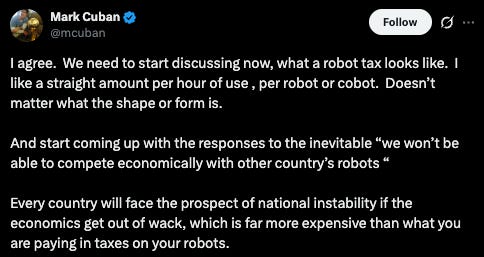
"Tax the Robots" is the dumbest idea I've heard Mark Cuban utter.
I spent the first part of my career on Wall Street, obsessed with a single variable: Alpha.
At the hedge fund I co-founded, we chased it by automating grunt work: building systems to read financial statements faster than any army of junior analysts could.
We didn't call it "AI" back then. It was just ML.
Today, I operate on the other side of the equation. At McDonagh Technologies, I engineer the kinds of systems I used to dream about on the trading floor. I run a single-family office, layering capital with operational support, and I spend my nights deep in ML research papers or tweaking context engineering protocols for my own agents.
I know how money moves, and I know how code is built. And from this vantage point, I can tell you that the rising political chorus of "Tax the Robots" is one of the most dangerously economically illiterate ideas of our young century.
...and its coming from people who are not well-positioned to monetize robots, funny how that works.
It is an attempt to solve a 21st-century existential crisis with 20th-century tool. It is the equivalent of trying to regulate the internet by weighing modems.
We need to talk about why this idea is gaining traction, the disastrous implications if we implement it, and why, as a builder of computational intelligence, I believe taxing efficiency is the fastest way to impoverish us all.
Part I: The Panic
I understand the panic. Truly.
Governments across the developed world are staring into a fiscal abyss. Our entire social safety net (Social Security, Medicare, infrastructure funding) is predicated on payroll taxes.
We tax human labor to pay for human needs.
But what happens when the connection between "production" and "human sweat" is severed?
If I deploy an AI agent that automates the work of five RevOps analysts, the company’s output goes up, but the government’s tax revenue from those five salaries goes to zero. The fiscal machinery breaks.
The populist response, shifting from "Tax the Rich" to "Tax the AI" feels intuitive. It’s a reflex to capture the value where it’s being generated.
Imagine a former Uber driver. Tired of the grind, they take out a loan and buy a fully autonomous vehicle. They send the car out 24/7 to act as a robo-taxi. The former driver is no longer a laborer.. they are a nano-capitalist owning means of production.
Under current laws, that car generates revenue, but it doesn't pay payroll tax. It doesn’t get sick. It doesn't need sleep. The argument goes: To level the playing field for human drivers and to fill the government’s coffers, that robot car must pay a special "automation tax." It should be taxed at a higher rate than a human because its efficiency delta is so much higher.
On the surface, to a policymaker desperate to plug budget holes, this looks like a solution. To an engineer, it looks like a nightmare.
Part II: Defining the Undefinable
The moment you move from abstract political slogans to actual implementation, the "Robot Tax" falls apart.
My fundamental objection is this: Taxing robots is as stupid as taxing computers based on MIPS (Million Instructions Per Second) or any other form of power ranking.
If you tax compute power, you are penalizing efficiency. You are placing a legislative drag on the very engine of economic growth.
The first insurmountable hurdle is definition. What is a "robot" in 2025?
Is it the physical arm in a Tesla factory? Sure, that’s easy to tag. But what about the Python script I wrote last night that automated a complex data reconciliation process between three different APIs, saving my Ops team 20 hours a week? Is that a robot?
Where do I send my tax bill?
Is it every time the script runs?
Every time I get benefit from it?
What about a highly optimized Salesforce Flow that replaces a human data-entry clerk? What about a fine-tuned LLM agent handled via context engineering that outperforms a mediocre copywriter?
If you tax physical robots, innovation will flee entirely into software. If you try to tax the software based on its "human replacement value" you are entering a labyrinth of impossible measurements that make the mouths of regulators in the EU salivate with anticipation.
Are we going to have IRS auditors counting floating-point operations? Are we going to tax neural networks based on their parameter count?
If we go down this road, we actually incentivize "Dumb AI."
Companies will deliberately engineer fragmented, less efficient systems just to stay under the "smart tax" threshold.
Does that sound stupid?
I’ve seen companies contort themselves to avoid certain compliance brackets; they will absolutely cripple their own tech stack to avoid a punitory efficiency tax. We will stop building Lamborghinis and start building countless compliant Toyotas, capping innovation just to dodge a levy.
Part III: Capital Flight
I hope I am making this clear: this approach fundamentally misunderstands the nature of modern tech.
In my investment life, I move capital. In my engineering life, I move code. Both are hyper-mobile.
If the United States, for example, decides to impose a hefty "Automation Surcharge" on AI processes, the reaction will be instantaneous. The beauty (and terror) of backend engineering is its geographic agnosticism.
I can host my revenue-generating AI agents on servers in Dublin, Singapore, or a newly minted "AI Haven" in the Caribbean just as easily as I can host them in AWS #2.
If you tax the "robots" the robots will leave. The taxing jurisdiction won't just lose the tax revenue; they will lose the entire industry, the supporting infrastructure, and the brain trust that builds it. You don't get to tax the golden goose if it flies to a different coop.
But let’s go back to our "Self-Driving Capitalist", the small business owner with one autonomous car.
A flat or aggressive automation tax doesn't hurt Waymo or Uber. They have economies of scale that beggar belief. They can absorb the compliance costs. The robot tax hurts the little guy trying to claw their way out of the labor class and into the ownership class.
If we tax automation heavily, we guarantee a winner-take-all outcome. Only the massive monopolies will have the margins to run automated fleets. The tax designed to protect the "worker" end up crushing the smallest "owners," ensuring the benefits of AI accrue only to the largest balance sheets.
Now we get to the part Mark has no idea about.
Part IV: The Trillion-Dollar Opportunity Cost
My deepest frustration with this entire line of thinking stems from my obsession with generating real-world value.
When we tax compute, when we penalize efficiency, we are actively choosing poverty.
We are standing on the precipice of the greatest unleashing of productivity in human history. We have the tools to crash the cost of healthcare diagnostics, transportation, legal services, and education to near zero.
If we allow AI to run unimpeded, we lean into massive deflation.
Imagine a world where my self-driving capitalist's car rides cost pennies because the efficiency is so high. Imagine medical scans analyzed by AI for virtually free. In this world, human labor becomes less central to survival because the cost of living collapses.
The "Robot Tax" is an attempt to keep prices artificially high to protect human labor that is no longer competitive. It is a dereliction of our duty to maximize human flourishing.
By trying to tax the process of value creation, we risk stopping trillions of dollars of value from ever forming. We are confusing the map (the tax code) with the territory (the actual economy).
I am not naive. I know the payroll hole is real. As someone who manages significant capital, I know fiscal stability is a prerequisite for a functioning market.
If machines are doing vastly more work, and humans are doing less, the tax base must shift.
But as an engineer, I beg policymakers: Do not tax the kinetic energy of the system. Do not tax the MIPS. Do not tax the code that is solving problems. Do not listen to business hype men who aren't technologists.
If you tax the robot, you destroy the robot.
If we allow this technology to flourish, immense surpluses will be generated. That money will have to go somewhere. In a world of abundant digital labor, value will flow fiercely into scarce physical assets. Real estate. Land. Things they aren't making any more of.
If you must recapture value, tax the surplus, not the source. Move toward aggressive Consumption Taxes or VAT, where the person enjoying the fruits of this hyper-efficient society pays their share when they spend.
Tax the person buying the yacht made cheap by robotic labor; don't tax the robot that built it.
We need builders right now.
We need to apply data to generate real-world scale.
We cannot afford to let 20th-century tax anxiety cripple 21st-century engineering.
Let the machines run. We can figure out how to distribute the bounty once we actually create it.
Don't listen to Mark.
Friends: in addition to the 17% discount for becoming annual paid members, we are excited to announce an additional 10% discount when paying with Bitcoin. Reach out to me, these discounts stack on top of each other!
Thank you for helping us accelerate Life in the Singularity by sharing.
I started Life in the Singularity in May 2023 to track all the accelerating changes in AI/ML, robotics, quantum computing and the rest of the technologies accelerating humanity forward into the future. I’m an investor in over a dozen technology companies and I needed a canvas to unfold and examine all the acceleration and breakthroughs across science and technology.
Our brilliant audience includes engineers and executives, incredible technologists, tons of investors, Fortune-500 board members and thousands of people who want to use technology to maximize the utility in their lives.
To help us continue our growth, would you please engage with this post and share us far and wide?! 🙏