
America’s Energy Dominance Strategy

For half a century, American energy policy was written from a position of fear. Fear of foreign oil. Fear of hostile cartels. Fear of unstable chokepoints. Fear that the world’s greatest industrial economy could be throttled by men sitting on fields we did not control, beneath regimes we did not trust, across oceans we had to police.
We built foreign policy around scarcity.
We tolerated trade deficits as if they were gravity.
We treated energy dependence as an unavoidable tax on prosperity.
We sent capital outward, imported vulnerability inward, and called the arrangement “strategic”.
That era is over.
The United States did not negotiate its way out of energy dependency. It engineered its way out. It did not beg hostile producers for mercy. It drilled, fractured, piped, refined, liquefied, transmitted, exported, and optimized. It converted geology into leverage. It converted private risk capital into national power.
It converted a structural weakness into a strategic weapon.
In 2000, the U.S. produced 69.262 quadrillion British thermal units of energy and still ran a net energy import deficit of 24.904 quads.
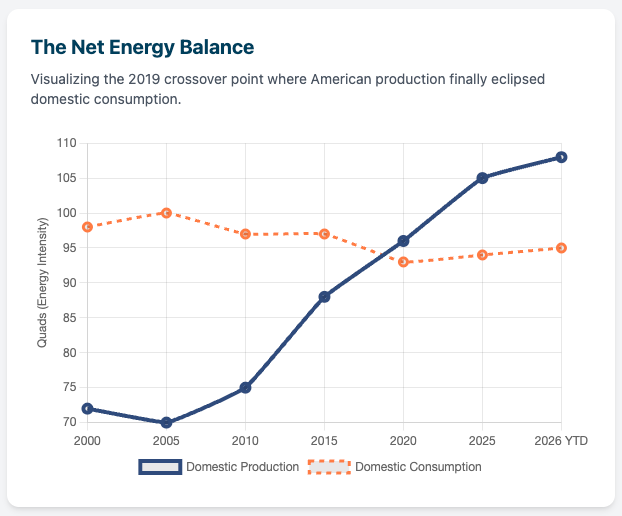
By 2019, annual energy exports exceeded imports for the first time since the early 1950s, driven by shale oil, natural gas, LNG capacity, and the collapse of crude import dependency.
This was not a policy slogan. It was a system-level reversal.
Energy dominance means something deeper than independence. Independence implies defense. Dominance implies agency. It means the United States is not merely trying to keep the lights on inside its own borders. It is shaping global energy flows, underwriting allied grids, suppressing the power of hostile exporters, and creating a domestic industrial base that can absorb shocks the old America would have imported straight into its bloodstream. True energy power is not autarky. The United States still imports, blends, refines, and trades. But it now does so from optionality, not desperation.
The old world asked: “Where will America get its energy?” The new world asks: “How much of America’s surplus does the world need?”
The answer is increasingly obvious. In 2024, the United States exported roughly 30% of its domestic primary energy production, shipping record volumes into Europe and Asia.
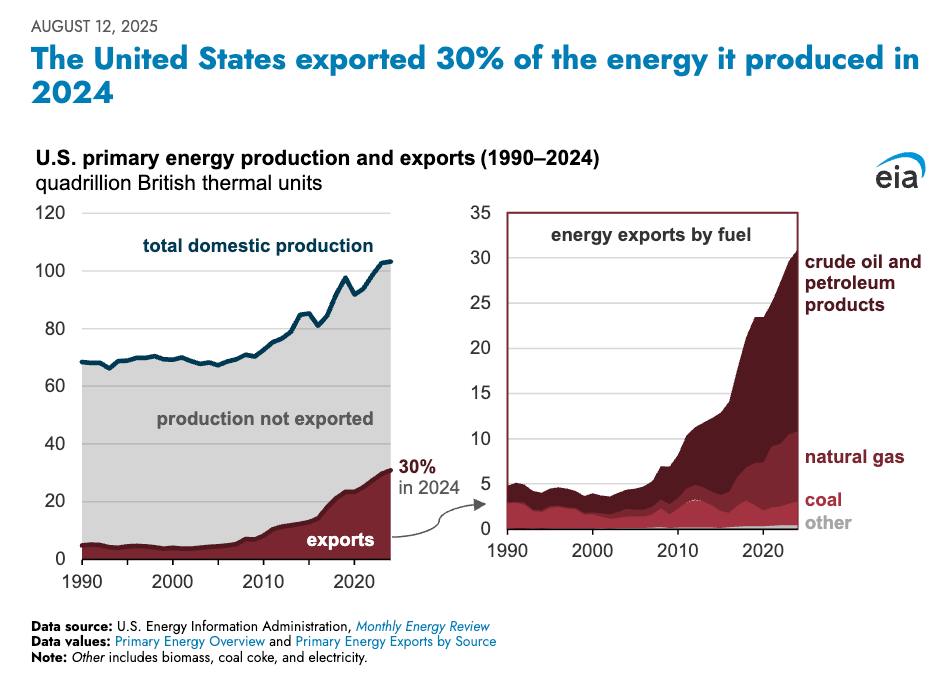
The EIA reported that of roughly 103 quads produced in 2024, about 31 quads went to other countries, with nearly all exports consisting of fossil fuels moving through global markets that now depend on U.S. supply depth. (U.S. Energy Information Administration) That is not a footnote. That is a geopolitical operating system.
The first pillar of America’s energy dominance strategy is hydrocarbon supremacy. This is the foundation. You do not run an industrial civilization on wishes. You run it on dense, dispatchable, transportable energy. Petroleum still powers the transportation arteries of the economy. Natural gas still anchors the electrical grid, heats homes, feeds industry, backs up renewables, and keeps manufacturing alive. The shale revolution turned tight rock into national leverage.
Horizontal drilling and hydraulic fracturing did not just increase production... they changed the bargaining position of the American Empire.
The numbers are wild.
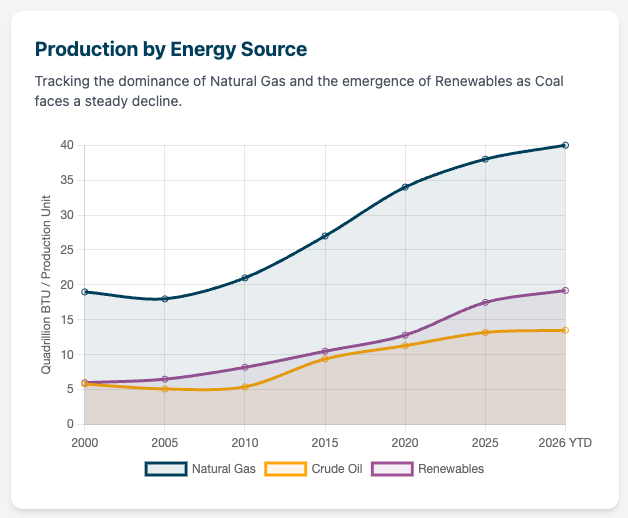
By 2025, U.S. total energy production reached a new record of roughly 107 quads. Dry natural gas production climbed above 39 trillion cubic feet. Crude oil production reached a record 13.6 million barrels per day, with crude alone accounting for 26% of domestic energy production. Natural gas plant liquids reached a record 4 trillion cubic feet, feeding the petrochemical base that turns cheap molecules into high-value industrial output. (U.S. Energy Information Administration) This is what dominance looks like at the physical layer: basins, rigs, crews, pressure pumps, gathering systems, processing plants, pipelines, storage, terminals, and refineries moving in coordinated force.
But production alone is not strategy.
Production without logistics is trapped value.
A barrel that cannot reach a refinery is stranded geology. A molecule of gas without liquefaction capacity is a regional commodity. A watt without transmission is local noise. The second pillar is infrastructure scaling. America’s advantage is not just underground. It is in the machinery that moves energy from rock to refinery, from basin to port, from terminal to allied grid. LNG export terminals along the Gulf Coast turned domestic natural gas into diplomatic force.
Ports, pipelines, storage tanks, and shipping contracts turned abundance into reach.
The refining complex is one of the most under-appreciated weapons in the American arsenal. The United States does not simply produce crude and hope the world buys it. It operates a sophisticated refining machine capable of importing heavy, sour barrels, blending them with light domestic shale output, and exporting higher-value products into global demand. In 2024, refined petroleum product exports reached 11.448 quadrillion BTUs, with Canada and Mexico anchoring a deeply integrated North American energy bloc. This is energy arbitrage at sovereign scale: import strategically, process intelligently, export profitably, and harden the continent’s supply chain.
The third pillar is natural gas as the bridge fuel and industrial accelerant. Natural gas is the load-bearing wall of the modern American grid. It replaced coal because it was cheaper, cleaner, more flexible, and abundant. It enabled combined-cycle generation to scale. It gave renewables a partner. It lowered industrial input costs. It produced natural gas liquids that became feedstock for petrochemicals, plastics, polymers, and specialized fuels.
Natural gas has been the largest source of U.S. domestic energy production since 2011, and the 2025 surge to 39 trillion cubic feet confirmed that this is not a transient boom but an embedded production regime.
This matters because energy dominance is not just about exports. It’s about rebuilding the domestic industrial organism. Cheap, reliable natural gas gives factories a reason to exist here. Cheap feedstocks give chemical producers a reason to expand here. Reliable baseload gives data centers, semiconductor fabs, defense manufacturing, steel, fertilizer, glass, cement, and advanced manufacturing a foundation.
The nation that controls energy costs controls the economics of reshoring. The nation that can power the next industrial stack controls the next strategic cycle.
The fourth pillar is electron dominance: gas, nuclear, renewables, and transmission working as a coordinated grid, not as ideological tribes fighting for purity. An advanced civilization cannot afford religious energy policy. It needs power that is cheap, reliable, scalable, dispatchable, resilient, and politically survivable. Natural gas provides flexibility. Nuclear provides zero-carbon baseload. Renewables provide increasingly large volumes of low-marginal-cost electricity where geography and grid capacity cooperate. In 2024, renewables reached 23% of total U.S. electricity generation, surpassing both nuclear and coal in the generation mix, while nuclear stabilized around 8.165 quads in 2024 and 8.195 quads in 2025.
We are not choosing between molecules and electrons. We are stacking them.
Expect to see a lot more nuclear in the future!
This is the part the ideologues miss. A serious energy strategy does not kneecap hydrocarbons to flatter climate theater, and it does not reject nuclear or renewables to perform nostalgia.
It is smart to compound every advantage. Drill where drilling is rational. Build pipelines where pipelines are needed. Expand LNG where allied demand exists. Preserve and extend nuclear where baseload matters. Deploy solar and wind where they are economically and geographically sensible. Build transmission because trapped electricity is stranded capital. Harden the grid because an electrified economy with a fragile grid is a hostage.
The fifth pillar is efficiency as a weapon. Dominance is not only producing more. It is needing less energy per unit of output. A wasteful empire burns its advantage. A disciplined empire compounds it.
In 2024, U.S. primary energy consumption per real dollar of GDP stood at 4.04 thousand Btu per chained 2017 dollar, evidence that the economy now converts energy into wealth far more efficiently than previous industrial structures. This is not weakness. This is leverage. When production rises while domestic consumption stays structurally contained, the surplus becomes export power.
That surplus is the strategic prize. In 2024, U.S. production hit 103.537 quads while consumption sat at 94.544 quads. In 2025, production climbed again to 106.913 quads while consumption was 96.209 quads, pushing the net export margin to 10.956 quads.
The divergence between production and domestic burn is the machine.
Every efficiency gain at home frees more energy for foreign revenue, allied security, and geopolitical pressure against competitors. Every barrel not required domestically can become an export. Every molecule not burned inefficiently can become leverage.
The sixth pillar is alliance power. Energy exports are not merely commercial flows. They are diplomatic bonds. When Europe reduces dependence on Russian pipeline gas, American LNG becomes more than fuel, it becomes strategic insulation. When Mexico and Canada integrate with U.S. crude, refined products, and natural gas flows, North America becomes a continental energy fortress. When Asian buyers diversify away from fragile chokepoints and hostile suppliers, U.S. molecules become geopolitical insurance. Energy dominance gives America something more useful than rhetoric. It gives America control.
This is why export capacity is not an afterthought. It is grand strategy.
An America that produces only for itself is strong. An America that produces enough to stabilize allies is powerful. An America that can flood markets during cartel manipulation can compress the leverage of hostile producers. An America that can provide LNG, refined products, coal exports where demanded, petrochemicals, and crude at scale turns geology into statecraft.
The seventh pillar is capital discipline. Energy dominance was not produced by slogans. It was produced by capital expenditure, engineering iteration, legal frameworks, mineral rights, private operators, risk tolerance, bankruptcy cycles, efficiency gains, and ruthless learning curves. The shale patch learned to drill faster, complete better, recover more, and survive lower prices. LNG developers learned to turn stranded gas into global contracts. Renewables developers learned to scale manufacturing, installation, and financing. Systems improve when capital is allowed to test, fail, restructure, and redeploy.
This is why the policy objective should be brutally clear: remove artificial bottlenecks while preserving operational standards.
Permit faster.
Build transmission.
Approve pipelines where needed.
Expand export terminals.
Develop more nuclear.
Modernize the grid.
Support storage where it actually improves reliability.
Protect domestic refining capacity.
Accelerate interconnection queues.
Harden physical and cyber infrastructure.
Stop treating energy abundance as an embarrassment. The world is not becoming safer. Industrial power is returning as the core measure of national strength.
The countries that win the next century will not be the countries with the cleanest slogans. They will be the countries with the most reliable power.
AI data centers, autonomous factories, advanced defense systems, desalination, robotics, electrified transport, semiconductor fabs, and resilient cities all require energy density and grid reliability. The next strategic contest will not only be about who has the best algorithms. It will be about who can power them. Intelligence without electricity is a dead asset. Manufacturing without heat is a fantasy. Sovereignty without fuel is theater.

If the United States wants to dominate AI, advanced industry, defense production, and space infrastructure, then energy abundance is not optional. It is the root asset.
The American strategy in one sentence: produce more, waste less, move faster, export intelligently, and harden everything.
This is not an argument for mindless extraction. It is an argument for intelligent abundance. The country should not burn resources stupidly, pollute carelessly, ignore environmental risk, or confuse volume with strategy. But it should also reject the anti-industrial instinct that treats energy scarcity as virtue.
Scarcity does not create morality. Scarcity creates dependence. Dependence creates weakness. Weakness invites coercion.
The cleaner path is not poverty with better branding. The cleaner path is technology, efficiency, nuclear durability, gas reliability, renewable scale, industrial discipline, and relentless infrastructure execution.
America’s energy dominance strategy is ultimately a sovereignty strategy. It gives households price stability. It gives manufacturers confidence. It gives allies alternatives. It gives diplomats leverage. It gives the military operational depth. It gives entrepreneurs cheap inputs. It gives the grid redundancy. It gives the nation options when the world breaks.
The old America imported energy panic. The new America exports energy stability.
Decline is not destiny when a country still has operators, engineers, capital, geology, infrastructure, and will.
The task now is not to celebrate the machine. The task is to expand it.
Drill the basins. Build the pipes. Upgrade the grid. Export the surplus. Defend the terminals. Preserve the refineries. Extend the reactors. Scale the renewables. Train the workforce. Compress the permitting timelines. Protect the cyber layer. Use efficiency not as an excuse for less ambition, but as a weapon that frees more supply for strategic deployment.
Energy is not a sector. Energy is the substrate beneath every sector.
We cannot export intelligence if we import energy.
A nation with abundant, diversified, export-capable energy shapes the world’s operating conditions. That is the position America is in. That is the advantage now on the table.
Now we must use it productively to scale our intelligence machinery, scale robotics and transform into a multi-planetary species.
Friends: in addition to the 17% discount for becoming annual paid members, we are excited to announce an additional 10% discount when paying with Bitcoin. Reach out to me, these discounts stack on top of each other!
Thank you for helping us accelerate Life in the Singularity by sharing.
I started Life in the Singularity in May 2023 to track all the accelerating changes in AI/ML, robotics, quantum computing and the rest of the technologies accelerating humanity forward into the future. I’m an investor in over a dozen technology companies and I needed a canvas to unfold and examine all the acceleration and breakthroughs across science and technology.
Our brilliant audience includes engineers and executives, incredible technologists, tons of investors, Fortune-500 board members and thousands of people who want to use technology to maximize the utility in their lives.
To help us continue our growth, would you please engage with this post and share us far and wide?! 🙏