
AI Has Changed Software Engineering
And the Smart Engineers Couldn't Be Happier

We are diving into the implications of the most recent AI breakthroughs across all areas of society.
We begin with the nerds who made this AI thing in the first place.
How has AI changed building software?
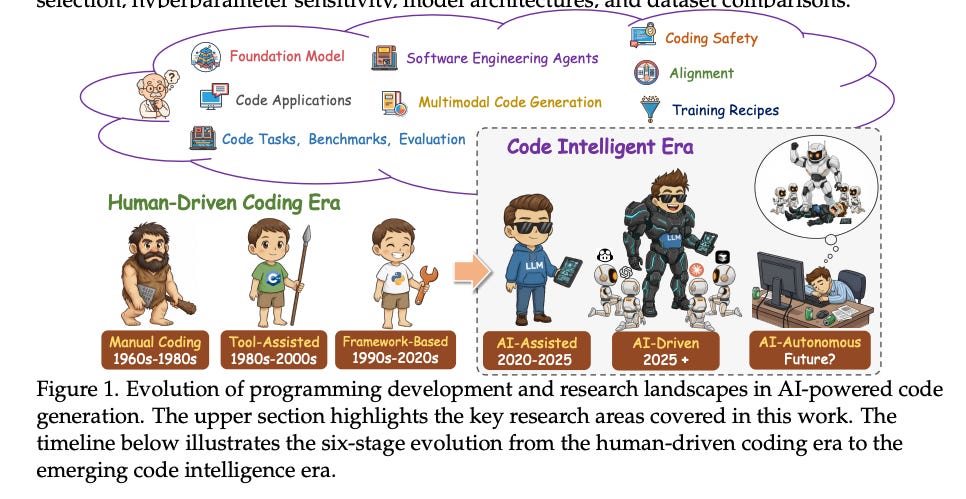
The era of the artisan coder is ending.
We are not witnessing a mere upgrade in tools. We are witnessing the industrialization of thought.
The research paper you are looking at, From Code Foundation Models to Agents and Applications, is not a survey. It is a declaration of a new world order in software engineering. It exposes a fundamental shift from human-driven development to an autonomous, AI-driven reality.
The Core Problem The “Human-Driven Coding Era” is defined by a fatal friction: the bandwidth of the human mind. We are slow. We are prone to error. We are constrained by biological fatigue. Our current infrastructure consists of manual coding, brittle heuristic tools, and fragmented frameworks. These methods cannot scale to meet the exponential demand for digital complexity. We have been fighting a modern war with muskets.
The Mechanism The solution is the deployment of Code Large Language Models (Code LLMs) and Software Engineering (SWE) Agents. This is a full-stack revolution. It begins with the strategic curation of massive data troves like “The Stack”. It moves through rigorous pre-training and instruction tuning. It culminates in Reinforcement Learning with Verifiable Rewards (RLVR). These are not chatbots. These are engines capable of planning, executing, debugging, and deploying software autonomously.
We have achieved the capability to translate natural language intent directly into functional, repository-scale executable code with a success rate climbing toward 95% on standardized benchmarks like HumanEval.
BATTLEFIELD ASSESSMENT
The Old Guard
For decades, we relied on the “Human-Driven Coding Era”. This period, spanning from the 1960s to the 2020s, was characterized by manual labor. It was inefficient. It was fragile.
We used primitive tools. We used static analyzers. We used rule-based heuristics.
These methods were “inherently brittle”. They were optimized only for narrow domains. They were incapable of generalization across the vast diversity of programming contexts. They required a human operator to micromanage every instruction. This is a logistical nightmare. It creates a bottleneck where innovation is throttled by the typing speed and cognitive load of the engineer.
The Hard Pivot
But there is a problem with the status quo. We were lied to about the necessity of human intervention in syntax generation. The advent of the Transformer architecture destroyed this assumption.
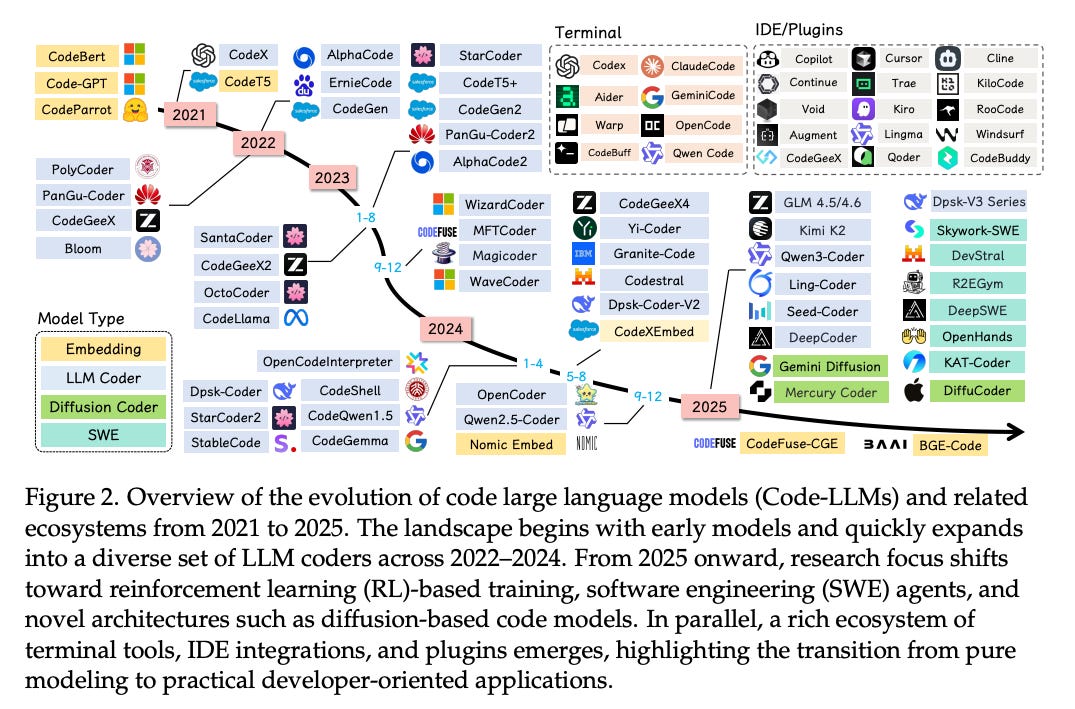
We realized that code is not just a set of rigid rules. It is a language with “compositional semantics and contextual dependencies”. By training models on massive corpora of code, we unlocked emergent behaviors that were never explicitly programmed. We unlocked instruction following. We unlocked reasoning. We unlocked planning.
The Weapon
The innovation detailed here is the Code LLM Pipeline. It is a weapon of mass construction.
It operates on two fronts. First, we have Generalist Models. Systems like GPT-5 and Gemini 3 provide broad reasoning capabilities. They leverage vast corpora of natural language alongside code to develop a nuanced understanding of context and intent. Second, we have Specialist Models. Systems like StarCoder, DeepSeek-Coder, and Code LLaMA are forged specifically for the syntax of war. They achieve superior performance on code-specific benchmarks through focused pre-training on programming-centric data.
These specialists utilize architectures like Mixture-of-Experts (MoE) to balance massive scale with inference efficiency. They do not just predict the next token. They utilize “Fill-in-the-Middle” (FIM) objectives to understand context bidirectionally. They are trained on “The Stack”, which contains terabytes of permissively licensed code. This allows them to internalize the logic of millions of developers.
The Shift
This matters now because we have crossed the threshold of utility. We have moved from single-digit pass rates to solving complex, repository-level problems.
We are no longer building tools to assist the pilot. We are building the autopilot. We are building the autonomous code factory.
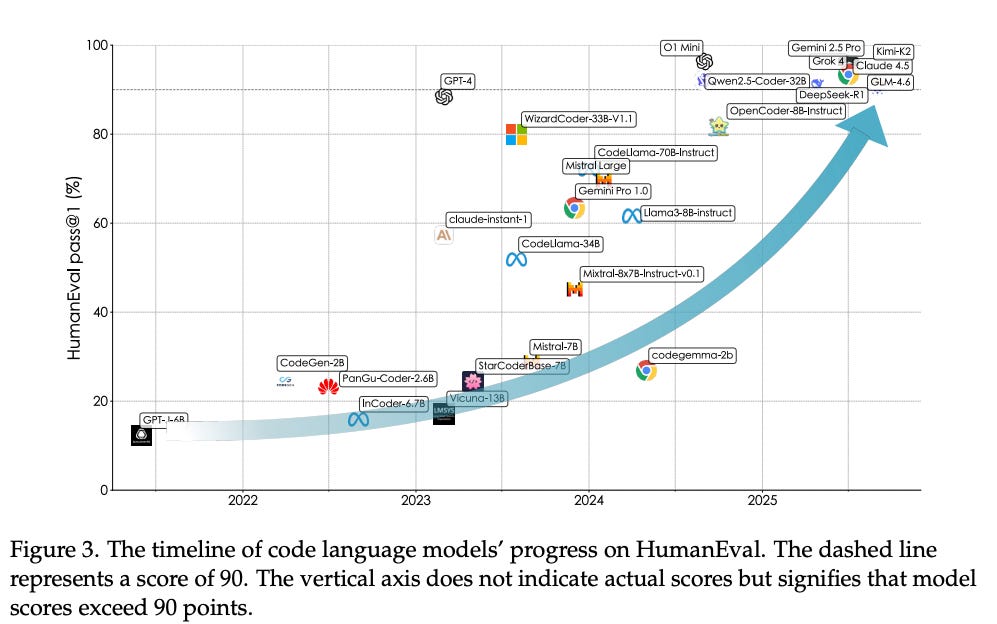
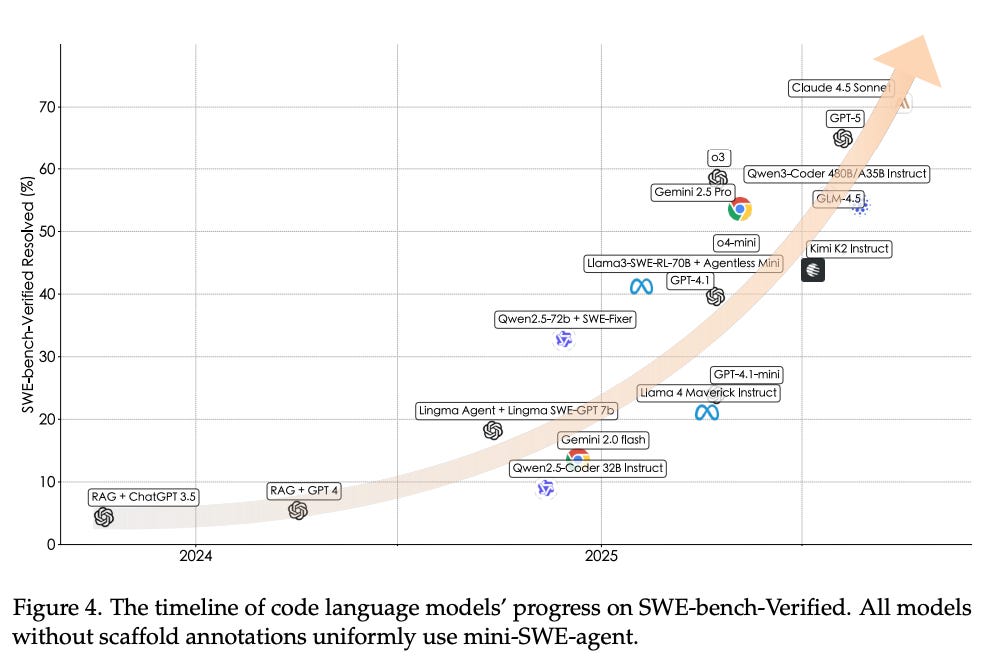
The research confirms a transition from “AI-Assisted” (2020-2025) to “AI-Driven” (2025+) and ultimately “AI-Autonomous” systems. The enemy is no longer the complexity of the code. The enemy is the failure to adopt this leverage.
THE BLUEPRINT
The Automated Code Factory
Stop thinking of this as “writing code.” You must visualize an Automated Code Factory, imagine the code itself as ordinance. I love a good explosive metaphor.
The Raw Ore
